Sunday, July 22, 2007
Structured Fun
Labels: 1950's, mental hygiene, PSA
Saturday, July 21, 2007
Unstructured Clouds

Here's a very cool and creative collection of pictures that play around with clouds and forced perspective.
Labels: clouds, Cool, meteorology
Friday, July 20, 2007
The Roadrunner Rules
Mark Rosewater, who is one of the major creative forces behind Magic: The Gathering, has a saying that restrictions breed creativity. It would appear that Chuck Jones, who was arguably the driving force behind Warner Brother's Looney Tunes cartoons, would agree. Here are the nine rules which governed the creation of the Roadrunner and Coyote series of classic cartoons.
1. The Road Runner cannot harm the coyote except by going "Beep-beep!"
2. No outside force can harm the coyote—only his own ineptitude or the failure of the ACME products.
3. The coyote can stop any time—if he were not a fanatic.
4. There may be no dialogue ever, except "beep-beep!" The coyote may, however, speak to the audience, occasionally with his own voice or through wooden signs that he holds up.
5. The Road Runner must stay on the road—otherwise, logically, he would not be called "Road Runner".
6. All action must be confined to the natural environment of the two characters—the southwest American desert.
7. All materials, tools, weapons, or mechanical conveniences must be obtained from the ACME Corporation.
8. Whenever possible, gravity should be made the coyote's greatest enemy.
9. The coyote is always more humiliated than harmed by his failures.
(source: Chuck Amuck: The Life and Times of an Animated Cartoonist)
Labels: cartoon, interesting, loony tunes, roadrunner
Thursday, July 19, 2007
Wednesday, July 18, 2007
Unstructured Inspiration
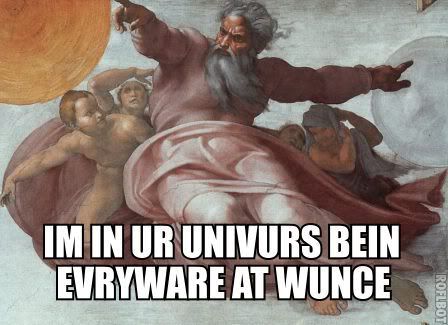
When I write an essay, such as the recent one on Omnipresence, I like to think that I'm inspiring my readers in some way. Mind you, I wasn't expecting the inspiration to take quite this form.
Labels: funny, Miscellania, religion
Tuesday, July 17, 2007
Unstructured Bunny Rabbit
Ever since we saw a yeti throwing a penguin, there have been a glut of games where the goal is to make some animal traverse some large distance (horizontal or vertical). Be that as it may, this latest one, which involves an insanely cute bunny jumping on bells in an attempt to get high (quit your tittering, you!) is surprisingly fun, addictive and, yet, soothing.
Labels: bunny rabbit, cute, Fun
Monday, July 16, 2007
Administrivia
Just a few notes on some modifications that I've made to the blog. The first is that I've had complaints that it was very difficult to get back to the main blog if you open an articles Permanent URL link. I've added a "Return to Main Page" link which will show at the bottom of the page after the last article (obviously, this won't have much use on the actual main page, so it can be ignored, there).
I've also gone through all of the old posts and added context links, which makes it easy to find related articles. For instance if you wanted to see all of my old Administrivia posts (and why the hell would you do a crazy thing like that), you could just click on the Administrivia label at the bottom of this article.
I've also noted that all the old audioblogger links for my poems are now officially dead, which rather sucks given how much of a PITA it was to narrate them. I'm still looking for a good way to do audioblogging that won't cost me an arm and a leg. If you happen to know of a good option, do pass it along.
Labels: administrivia
Beer Activated Girl
With a title like Beer Activated Girl, you'd think that this parody of Coin Activated Boy would be utterly misogynistic but it actually manages to be rather sweet in an odd sort of way. Bonus points for using a cute, plus-sized model.
Sunday, July 15, 2007
On Omnipresence
The fact that I am an atheist who has an interest in theology isn't, in and of itself, surprising. In my entirely anecdotal experience, atheists, as a whole, tend to be more theologically away than the majority of theists. I suspect that this is explained by nothing so complex as basic philosophical self-defense: when you're constantly asked to justify your beliefs, it makes sense to understand the beliefs of your opponents.
Most atheists, however, tend to focus on the subject of theodicy, which pertains to arguments that attempt to establish the existence of God (and let's be clear about something here; the vast bulk of theology, as a school of thought, focuses on the Abrahamic religions). While I have engaged in that sort of debate and even gained a fair amount of enjoyment from it, I find that my interest in it has waned over the years. The truth of the matter is that there are only about a dozen interesting arguments, one way or the other, which maybe a half-dozen interesting permutations each. Once you've covered the ground, there's really not much more of interest to be found. Likewise, if you haven't been convinced (again, one way or the other) after having gone over them, then very little is likely to change your mind. My suspicion is that less than 1% of the people who study theodicy are ever compelled to change their initial position and that the bulk of theodicy, in practice, is an elaborate game of mental self-reinforcement by means of elaborate rationalization.
So, if I'm no longer interested in theology, you may well ask, then what remaining interest do I have in theology? The answer is that, for me, theology is an interesting mental exercise. Let us postulate that there exists a Perfect Being. Having postulated said being, what characteristics would such a being necessarily have (or necessarily not have)? The actual existence or non-existence of the being is as irrelevant to me as the existence or non-existence of ideal circles is to a geometer.
In traditional theology, there are four particular traits which are reserved exclusively to the Perfect Being: omnipotence, omniscience, omnibenevolence and omnipresence. Of the two, omnipotence and omniscience garner the bulk of the attention with omnibenevolence trailing a distant third and nearly no attention, what so ever, being granted to omnipresence. This isn't especially surprising because, as human beings, we tend to be attracted to those things that we would most like to possess. If you were granted one unconstrained wish I think that most people would opt for ultimate power (even if it did come with the caveat that you couldn't then use it to get any of the other omni-traits), that a smaller number of people would be tempted by ultimate knowledge (indeed, that's what I'd want); some small number of people (bless their hearts!) might choose to be perfectly benevolent, but who in the world would wish for the ability to be everywhere at once!? Be that as it may, of the four omnis, omnipresence may well be the most interesting.
Consider this: what exactly does it mean to be omnipresent? The encyclopedic definition is to be present at evey point in space and time (which, by the by, also implies that our Perfect Being is eternal). Putting aside for a moment that the Abrahamic god is usually considered to be immaterial, this would imply that the Perfect Being can not coexist with anything else. Indeed, the existence of other things would seem to contradict the presumption that a Perfect Being exists (thus leading us straight back to theodicy). Let us consider a couple of possible alternatives.
The first is what I call the Jell-O model of deity which is what I suspect most people imagine when (and if they think about omnipresence. In this scenario, the Perfect Being fits into all the empty parts of existence. The fact that you and I are also in the universe doesn't contradict its existence because it it adjacent to every occupied point. Indeed, the Perfect Being doesn't simply surround us, it permeats us. All the spaces btween the protons, electrons and neutrons that make up our body are part of its Body and if it's not everywhere, it's close enough not to matter. Not a swallow falls that It does not feel (indeed, omnipresence, in a strange sort of way, may well account for the Beings omnipotence and omniscience).
Aquinas favored a model of omnipresence that saw God as being omnipresent only in as much as God had knowledge of all things, the ability to act upon all things, and who was the source of all things. In the Aquinan view, God is the basis of all realty and has no limits with respect to that reality, thus, even though God is an Other with respect to the elements of the universe, His relationship to the universe justifies a claim of effective omnipresence.
I believe that this model has a basic flaw: we can imagine a universe occupied by a similar being to the one that occupies our own with a single difference: in this possible world, there exists one less electron. The being that occupies this infinitesimally distinct universe would have one more loci that the being that occupies our own. As such, this being would have an even greater degree of omnipresence than our own. Since perfection is an absolute (there are no degrees of Perfection), it would follow that the being that is in our universe could not, in fact, be a Perfect Being, QED. By a process of reductio ad absurdiam we quickly find ourselves back to the starting point: the only perfect being is one that excludes all other beings from existence.
A less naïve model might be something I call the Organic model of deity. In this model, the Perfect Being is, indeed, unitary. All things that exist are part of the Perfect Being in the same way that your heart, lungs and liver are all part of you even though they can also be considered discretely. A popular variant of this idea is that all things exist as part of the Mind of God and that everything we feel and experience are simply the thoughts of the Divine Awareness. Charles Hartshorn goes this one better by suggesting that the relationship of the deity to the universe is one of a mind to its body, which is to suggest that there is simultaneously a duality and a unity between the divine and the mundane.
Whether we treat existence as the Perfect Being's body or mind, however (or some combination thereof), we are face the difficulty of the fact that the elements of existence are imperfect. We are faced, as one example, with the problem of evil. If all things are part of the Perfect Being, and evil exists in the universe, then the implication is that part of the Perfect Being is evil and, thus, imperfect.
It is possible to get around this apparent paradox by proposing that the whole is greater than the sum of its parts. By this proposal, individual aspects of the Perfect Being can seem imperfect when viewed in isolation while, never the less, contributing to a perfect entity when viewed in the aggregate, much as a circle is composed of arc segments that, by themselves, lack the geometric perfection of the circle to which they are a part.
While this formulation does have a certain intellectual elegance, it is morally problematic. If the apparent imperfections that we find in existence are an illusion created by an insufficient perspective then so too is the apparent evil in the universe. If we embrace this view we find ourselves in the uncomfortable position of having to deny, for instance, that the rape of a ten year old girl is, in any sense of the word, wrong. I suspect that few people would be willing to believe that we live in such a Panglossian reality. Never the less, the position does seem to be logically tenable.
The final option is to make an appeal to Mystery which is to say that we simply declare that even though the omnipresence of the Perfect Being is a fact, our ability to understand that fact is limited by our capacity to comprehend the nature of that fact. The question is "answered" by declaring it unanswerable.
Again, this is a logically tenable position and there is precedence in theology to declare that certain things presumed to be factual are, never the less, imponderable (the Christian doctrine of the Trinity being the classic example). While such an answer might provide an anodyne to religious belief, I don't find this sort of solution to be intellectually satisfying. Remember, for me theology is an abstract intellectual exercise. As such, I don't gain much pleasure by proposing a problem and then by "solving" the problem by declaring it insoluble by fiat.
Of course, we might well ask whether or not omnipresence is a necessary characteristic of a Perfect Being. One could make an Anselmian argument that a being that is less than absolutely present is less perfect than a being that is fully present, however, such an argument carries within it a circular presumption that degrees of presence have anything more to do with perfection then texture or color (must we presume that the Perfect Being is absolutely chromatic – whatever that might mean?). Be that as it may, it's hard to shake the feeling that a being that is otherwise absolute in every other aspect, but which is limited in space and/or time, is, indeed, less than a perfect being.
Alternatively, since we can argue that the existence of a Perfect being necessary excludes anything else but itself from existence, we can arrive at an anti-theodic conclusion that the existence of other things is a demonstration that the Perfect Being does not exist.
My own suspicion is that our definition of Perfection may, indeed, be faulty. I think that perfection my imply Totality, which is to say that a Perfect Being would be a kind of superset (a class?) that necessarily included within itself all possible things. I think that such a being would not, and could not, have a personality or, indeed, any sort of unified sentience since awareness, itself, would only be a subset of the whole and that no thought or set of thoughts could be privileged above any other set of thoughts. Such a being would be all possible thoughts, all possible peoples, all possible places, and all possible events. Such a being would neither be good nor evil but fully contain both. Such a being would, in short, be nothing less than Existence: impersonal and absolute.
Labels: Essay, omnipresence, philosophy, theology
Saturday, July 07, 2007
The Zombie Food Pyramid
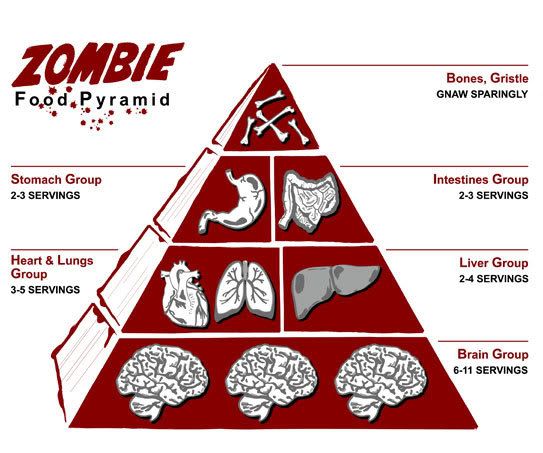
I'm always in the mood for good Zombie humor. This is something I stumbled on at Stacy Ponder's site.
Monday, May 28, 2007
Unstructured Meta-Fun
I've always loved meta-things and Lore Sjöberg (late of Brunching Shuttlecocks) has come up with a dandy one.
As you might have noticed, "what-am-I" quizzes have been proliferating. You can now know, with all the accuracy that the internet has to bear on the subject (ahem), what style of humor you have, whether or not you have a personality disorder, and which Simpsons character you are.
Lore's test goes beyond this basic paradigm. Instead of finding out who you are from a quiz, you tell the quiz who you are. The idea is that you then pass the quiz along to your friends and they try to guess what your answers would be (he compares it to being a bit like the Newlywed Game but with no questions about whoopee).
Here's my swap quiz. You can, of course, create your own.
A Book Burning in the South
It's usually a sad enough affair when one hears about a book burning in the South, but news of the latest book burning is particularly sad because the person who's doing it loves the books he's destroying.
Tom Wayne is the proprietor of Prospero Books in Kansas City, Missouri. Over the years, he's amassed a backlog of some twenty-thousand books. Recently he decided that it would be a good idea to donate that backlog to libraries and thrift shops but was nonplussed when he was told that they already had more than enough books, thank you very much.
Tom Wayne is a dispirited man. He has discovered that our culture no longer places much value in books. According to the National Endowment for the Arts, reading for pleasure has dropped over 57% in the last two decades. Tom says that he often goes to yard sales where there are four televisions for sale and only three books… a claim that doesn't sound the least bit preposterous to me.
Tom's book burning is a protest, of sorts. He describes it as the "funeral pyre for thought in America".
While, I can't bring myself to agree with his methods – I feel too much of a visceral connection to books to ever condone their burning, whatever the justification – I can certainly understand his frustration and the basic motive of his protest.
Labels: books, Commentary, culture, sad
Wednesday, May 09, 2007
Fat Like Me
I was a skinny kid; one of those kids who could eat chocolate sundaes for each of my three meals followed by pound cake for dessert. Sadly, that all started to change right around the time I was sixteen when one of my friends helpfully pointed out to me -- while at a pool in front of all my other friends -- that, hey, I was getting fat. (I wanted to thank him with a crowbar).
There are many things that suck about being fat (and at 225 pounds, I'm not going to retreat to euphemisms), but the worst, in my opinion, is the general perception that if someone's fat it's because they've let themselves become fat. There's a smug inversion to that sentiment, too. If someone is thin, they can pride themselves on their wonderful willpower which is evidenced by the simple fact that they aren't fat. I suspect that one of the reasons that obesity is still a safe port for public humor (as opposed to, say, ethnicity) is that there is a perceived moral dimension to weight. If your fat, it is seen as a reflection of your character: you are guilty of being a willful glutton.
When fat people object that their weight isn't their fault, their protests are usually met with skepticism if not outright derision. Do we not have control over what passes through our mouths? Could we not simply eat a little bit less? The reality, however, is that weight actually does have less to do with willpower than most people assume. The first evidence of this came from the research of Jules Hirsch, in 1959.
Hirsch took obese volunteers and put them on a controlled diet. Their weight was painstakingly reduced to that of a normal person. What Hirsch discovered was that the volunteers bodies reacted to the weight reduction in two ways. The first was that the volunteers started to exhibit symptoms of starvation psychosis which mirrored the symptoms one might see in prisoners of war deprived or food or refugees on a starvation diet. The volunteers universally felt hungry to the point of starvation all the time. The second effect, which is even more insidious, was that their metabolisms literally slowed down by as much as 24% which meant that not only were they starving, but their bodies conspired to put weight back on them.
A converse study was performed by Dr. Ethan Sims who took thin volunteers and fed them a high-calorie diet to force them to gain weight and who then monitored what happened to them once they were off the diet. As you might expect, the results were a mirror image of the obesity trials. The volunteers lost their appetites and their metabolisms kicked into high gear. As a consequence, they couldn't help but to lose weight.
This has been further bolstered by twin studies. Identical twins separated at birth will almost inevitably have the same body-mass index while fraternal twins have similar BMIs. Likewise, adopted children are much more likely to have weights that resemble those of their biological parents than of their adopted parents.
The simple conclusion of these studies is that weight is primarily genetic. While it is possible for a fat person to starve themselves thin everything in their biology will fight against that thinness just as those who are naturally thin would have to exercise immense will to become and stay fat. Dr. Jeffrey Friedman has offered the analogy of holding one's breath: while it is possible to do so in contradiction to the instinct to breath, eventually the urge to breath becomes overwhelming.
As someone who is fat, I find this news simultaneously uplifting and depressing. It is good -- really good -- to know that I don't simply suffer from a defective will but it's also disheartening to think that I'll always be stuck with this weight.
There is the temptation to treat this information as license to eat whatever I want. After all, if my body has a natural weight that it wants to be, it doesn't really matter if I try to control my weight. I should be able to eat what I like without any pangs to my conscience. As it happens, I take pains to eat a healthy mix of foods and to keep my caloric intake to under 2,000 calories a day. I have three reasons for doing so.
- Because I am fat, I recognize that I'm more prone to certain health conditions. I am much more likely to develop adult onset diabetes (I have several siblings who already have) and heart disease. Eating nutritious foods won't guarantee that I won't develop a weight related condition but it will help to minimize the risk. The fact that I've been able to maintain a healthy blood pressure and cholesterol level are indications that this is a good strategy.
- Even though the bulk of our weight (no pun intended) is largely out of our hands, there's about 20 to 30 pounds of drift weight that is amenable to diet and exercise. Although I doubt that I'll even be able to get much below 220, I would rather be closer to 220 than to 245, which is where I was before I changed my eating habits. Even a difference of 20 pounds can feel significant. I have more energy than I did before and I feel much healthier than I otherwise would have. For simply quality of life, this is worth the effort.
- I know that whenever a thin person sees a fat person eating a cheeseburger, they nod to themselves and receive another bit of enforcement to their smug preconception that they're better than those of us who aren't thin. I don't want to give the bastards that sort of satisfaction.
Acknowledgement to the New York Times for reporting on the historical research. See Linked article.
Sunday, April 22, 2007
Unstructured Comparisons
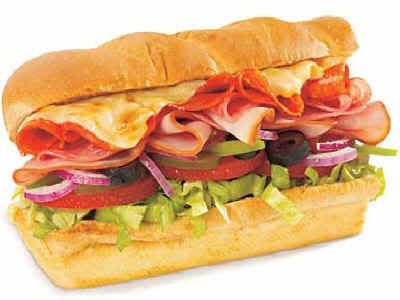
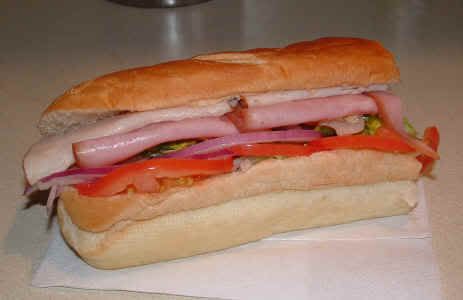
Food advertising is an art. I'm sure we've all heard how, when photographing cereal, they'll dot the flakes with Elmer's glue, along with all sorts of similar tricks. Well, someone took this observation to the next level and decided to do comparative photos of food ad copy and the actual food that you get from fast food joints. 

The one caveat that I would make is that some of the difference is due to the differences between professional lightning and natural light. That said, the results are certainly interesting.
Labels: Food, interesting
Saturday, April 21, 2007
A Few Thoughts
I know that I've been very quiet and I'm sure that my "three" readers are probably wondering what the heck has happened to me. I'm sorry to say that I've just been very busy and haven't had the mental energy to blog. I assure you that this isn't a permanent state, however. I have some ideas for essays that I want to write but I also want to be sure to get them the focus of my attention when I do write them.
In the meanwhile, here's an essay by one of the professors at Virgina Tech who's rebutting Dinesh D'Souza, who took the aftermath of the Virgina Tech tragedy as an opportunity to bash atheists. If there's one thing that makes me mad, it's when people spin tragedy in the name of agenda. I don't care if that agenda is gun control (pro andcon), anti-video game legislation, immigration, or secularism... all of which were wrapped around the shooting before the bodies were even in the ground. While I don't think that this is the time or place for a debate, this persons reply is eloquent and heartfelt and I think that it puts a nasty piece of public ugliness in its place.
People like Dinesh D'Souza have an axe to grind and they love nothing more than an excuse to grind that axe in public. They are attention whores of the worst order and I think that there must be something inside them that becomes thrilled when things like this shooting happen because it gives them one more chance to try to wedge themselves into the spotlight. While there is a part of me that feels that the best reply is silence there is the risk that silence equates to assent. This anonymous professor, who doesn't even care to put his name forward, challenges the D'Souzan vultures of the world with something better: the simple rebuke of shame.
Labels: atheism, Essay, popular culture, tragedy