Ross Douthat, of The Atlantic, worries that there is a looming glut of superhero movies.
I agree that it is very likely that his prognostication is on the mark: I fully expect for there to be a surplus of superhero movies over the next several years. What puzzles me, however, is that Ross seems to think that there's something unusual about this.
For all its ballyhooed liberalism, when it comes to financing projects, Hollywood is actually a very conservative town. Producers don't generally like to risk putting their money on risky projects. As a consequence of this, Hollywood tends to be self-imitative. When a movie is a success, the first thing most studios will want to do is to make a sequel. If several movies in a genre succeed, it's a safe bet that more movies in that genre will be produced.
The sorts of gluts that Ross is worried about are perfectly common. For decades, the studios cranked out an endless sequence of westerns and musicals. In the 70's, cop dramas were all the rage. In the 80's and 90's, you couldn't have summer without big action movies stuffed to the brim with explosions and car chases. We also passed through a science fiction craze and, if it weren't for a number of failures, I'm sure that we'd be neck deep in fantasies right about now.
While this type of repetition can get annoying, this is a case where the market invariably corrects itself over time. When people get tired of a genre, they stop spending money on it and as other genres become more successful the old is replaced by the new. I would not be surprised to see a lot of superhero movies out in the next five years, but I would be shocked if they were still making as many of them ten or fifteen years from now. Sooner or later people are going to decide that enough is enough.
Ross Douthat is not a fool when it comes to cinema. He's quite familiar with the history of the medium and I'm sure that he realizes that these movies are part of a larger cycle, so his concern is a bit puzzling. I suspect that the real nature of his concern might be found we he frets that "if we aren't careful, the next generation of Coppolas and Scorseses, De Niros and Streeps will spend the best years of their creative lives toiling away on Spiderman 8 or X-Men Origins: Kitty Pryde."
It would, indeed, be a sad thing if the next generation of talented actors were to find themselves trapped in superhero roles, especially given the risk of typecasting. This is not a trivial concern. One can consider the effect that Star Wars had on the Careers of Mark Hamil and Carrie Fischer (and I wonder if Elijah Wood will ever regret playing Frodo); however, I think that a case can be made that the more popular a genre becomes, the less likely it is that new talents will find themselves trapped in them.
The reason for this is that directors and producers want to hire the very best talent that they can afford for their productions. Likewise, actors tend to compete for those roles that are the most lucrative. This means that the most sought after roles will tend to go to the so-called A-List actors (with a similar effect for the directors). The next young De Niro won't be playing Iron Man precisely because the role is going to go to Robert Downey Jr whose already established his credentials.
This might sound like a bad thing for Downey and it would be if he had no choice in the matter but, being an A-List actor, he has his choice of roles. The only reason for him to play Iron Man is because he wants to be in the Iron Man movie. No matter how saturated the market becomes, there will always be alternative roles (even lucrative ones) and no A-List actor or director will ever find themselves in a position where they are forced to make a movie where the principle character is wearing tights (and we're not talking Shakespeare).
As for the up-and-coming B-List actors and directors who have great potential, no one will hold it against them if they find themselves compelled to take frivolous roles. Hollywood well understands the concept of paying one's dues and so long as those bright talents can avoid the pitfall of typecasting, I don't think that such efforts will especially hurt their careers. And if they do succumb to typecasting, there's nothing especial about the superhero genre that promotes it. Good actors (and even directors) have fallen prey to that trap in every genre and it is simply something that they all need to be aware of.
So why is Ross concerned? I suspect the real reason is not that he fears that good actors will be forced to play genre roles but that he fears that they will be tempted by such roles. I think that Ross loves the cinema and that, as much as he is willing to tolerate and even enjoy the occasional superhero lark, he wants the best actors playing the roles that he considers to be the most serious, just as he wants the best directors to be working on those works of art that exemplify all that cinema can be.
Mind you, I could be wrong. I don't know Ross Douthat personally and this supposition should be read as conjecture. Never the less, if that is the root of his concern, I think he worries for naught. The very best directors aren't going to feel compelled to follow the crowd. When Kubrik made 2001: A Space Odessey and A Clockwork Orange it wasn't because he thought that he had no choice but to make science fiction (indeed, he made them at a point where most directors were disdaining the genre). Likewise, the De Niros of the world will do as they will precisely because they are 800 pound gorrillas who are fully aware of the weight they can throw.
But even if some top-mark director or actor desires to make a genre film, so what? They are adults and it is up to them to decide what is and is not dignified for them to do. Robert Downey Jr.'s Oscar isn't tarnished because he decided to don a gold and red suit just as Kubrik wasn't diminished for dipping into the horror genre with The Shining. Whether or not someone like Ross thinks that such projects are unworthy of the participants is irrelevant so long as those participants have any choice in the matter and I don't believe that he's made the case that they don't.
Monday, May 12, 2008
A Superhero Glut?

Wednesday, May 07, 2008
On the Successes and Failures of Superhero Movies
Natalie and I saw the new Iron Man movie over the weekend and were much impressed by it. So much so, in fact, that it led to a late-night discussion at Denny's (which is the natural environment for late-night discussions) over why the Iron Man movie worked (in our opinion) so well and why so many other superhero movies have been disappointments. This, in turn, led me to consider the general factors that influence the success or failure of such efforts and why making superhero movies is a risky (albeit potentially lucrative) venture.
Character Matters
Outsiders to the genre often make the mistake of thinking that superhero movies are primarily, or even only, about the pyrotechnics and the effects. They believe that people who like superheros are only really interested in over the top fights where hyper-muscular beings punch one another into and through major structures.
Given that the central defining characteristic of the genre is, in fact, super powers (or their technological equivalent), such a misconception is understandable and, indeed, a superhero comic that never had super-powered combat scenes would be rather dull. Never the less, a comic that focused solely on fight sequences and spectacle would also be rather dull for the typical fan of the genre. Big fights are a part of the draw but what really keeps the attention of fans and leads fans to a state of loyalty to a title or a character are the story lines and, even more fundamentally, the characters in those stories.
If you ask a fan why a given character is his favorite, the answer is rarely only going to be that said character has cool powers. More often, the real reason is that the character is an interesting person and the fan has come to know and love that character's persona.
A lot of adaptations pay only minimal attention to their characters who are often treated as mere props for the powers that those characters possess. A good example of both successful and unsuccessful character adaptation can be found in the X-Men movies. Hugh Jackman has been justifiably praised for bringing the character of Wolverine to life in a manner that is simultaneously true to the comic as well as being interesting in its own right. By contrast, Halle Barry's Storm comes across as flat and lackluster in spite of the fact that she does, indeed, look the part and in spite of the fact that her character exhibits all of the powers that the Storm of the comics possesses.
Seriousness
Seriousness is a double-edged sword. Superhero comics are based upon a basically unrealistic premise: that there exists humans who have demi-godlike powers. On top of that, the tropes and storylines lend themselves to silliness. Pick nearly any hero and look up his or her entry on Wikipedia and it's difficult not to walk away with a feeling that the entire history of the character is built upon an endless layer of absurdities. Even the most grim and gritty stories in the genre have an essential silliness built into them.
In spite of that, if the stories are the work at all, they must take themselves seriously. The genre demands a willing suspension of disbelief (SoD) from the audience and, given how deeply at odds to reality the very fabric of the genre is, it is a very easy thing for an audience to lose that sense of suspension. A good superhero story has an internal logic that it needs to adhere to in order to maintain the SoD. Many directors, however, think that the unrealism of the genre means that they can approach it frivolously. Joel Shumacher's Batman films are good demonstration of why this is a bad idea. By presenting the audience with a camp environment that went out of its way to emphasize its childishness, he made a series of films that existed only to be mocked.
It is, however, possible to be too serious. The genre is flexible and artists such as Frank Miller and Alan Moore have proven that, in capable hands, it is possible to use the genre to create serious works of art. Never the less, most superhero stories suffer from efforts to turn them into high art. I suspect that this was at the core of what went wrong with Ang Lee's adaptation of The Hulk. What ought to have been a fun and enjoyable movie was turned into something dense and opaque in an attempt to create high art. While the character of the Hulk does lend itself to a certain degree of introspection regarding the conflict of reason and emotion (and any number of other topics), at the end of the day it's a story about a man who occasionally turns into a giant green monster. Even though Lee is a perfectly capable director, his desire to turn the Hulk into something intellectual and serious was a case of poor judgment.
The Fan Boy Effect
The fans of a comic series are the best and worst friends that a director has. A good film must court the fan base but, at the same time, it needs to appeal to an audience that may not be especially (or at all) familiar with the character.
Hard core fans tend to be obsessives. Any deviation from the source material is looked upon with grave suspicion and every decision a director makes is subject to endless rounds of second guessing in the chat rooms of the world.
A good director needs to know how to thread those worlds. The best directors are those that show that they understand and respect the original works while, never the less, being willing and able to modify the stories for the needs of the screen. It is entirely possible to be too faithful to an original work just as it is possible to be too contemptuous of it.
When Sam Rami was working on the first Spiderman movie, there was a great deal of debate in the fan community over Rami's decision to make Peter Parker's web shooting ability part of his body as opposed to the web-canisters that the Spiderman of the comics uses. Many fans felt that organic webs were a blatant and disrespectful violation of the canon. Rami and his supporters argued that, in spite of the canisters prominent history in the mythos, they were an unnecessary and, frankly, unbelievable element when translated to film. I believe that history has proven that Rami's intuition was correct: having Parker shoot the webs out of his wrists is much more intuitive for anyone who isn't already intimately familiar with the original stories.
The Perils of Origin
As a general rule, when films have sequels, the first movie is generally better than the second, the second is generally better than the third, and so forth. Although the sample size is smaller, superhero movies seem to follow rule where the first movie is usually weaker than the second, the second is usually the strongest, with subsequent movies being progressively weaker than either.
It has been suggested that the reason for this is that the first movie is almost invariably burdened with the task of telling the superhero's origin. This can seem rather counter-intuitive to comic fans given that good origin stories are the stuff of legend. Who would Peter Parker be without the tragedy of his Uncle's death? How much of Superman would be left if not for the elaborate myth of the end of Krypton? Origins aren't only crucial to understanding who these heroes are, they are some of the very best stories that the genre has produced.
Why then are origin stories such a detriment when brought to film. A big part of it is that film and comics are different media. A story that works well in the bright four-color paneled world of a comic can easily seem contrived and even fairly boring when brought to screen. Paradoxically, this is particular true when the character is popular enough that the general public is familiar with the character. Most people know that Superman was born on Krypton, that he was sent to Earth, and that he was raised by the Kents. Consequently, being forced to sit through an origin that they already know can be a boring thing. When people are less familiar with a character (as is the case with, say, Iron Man) it's actually easier to interest the audience in that story.
Because the origin story is such an integral part of the genre, however, directors are loath to dispense with it. So a good director has to find a way to tell a familiar story in an unfamiliar way. Both Tim Burton's original Batman movie and Christopher Nolan's Batman Begins dealt with the origin of Batman but even though the basic elements remained the same the execution, style and emphasis were wholly different. Consequently, very few people felt that the latter simply retrod the ground laid down by the former. Doing this, however, requires an exceptional degree of talent and many directors simply aren't up to the task of making the origin story as interesting as it needs to be.
And So Forth
Anything that can make a non-superhero movie bad can do the same to a genre film. There are an infinite number of ways to ruin a film from slipshod continuity to poor casting to tin-eared dialog, etc. All the ordinary problems that face any movie confront the director of a superhero film. However, in addition to those normal pitfalls there are additional ones. A good movie can be ruined by bad special effects. Sometimes the very project is an uphill battle because the character is either not well known outside of the genre (such as Elektra) or is simply not that great of a character to being with (such as the Sub-Mariner).
There are so many difficulties facing this style of movie that one might feel surprised that any of these movies can succeed, much less succeed spectacularly; however, when a superhero movie does hit all the right notes, it can tap into that same mythic well that makes the comics such an enduring part of our cultural landscape. The original Superman movie promised that we would believe that a man could fly... and we really did. Rami's Spiderman brought us into the conflicted world of Peter Parker and made us see why his powers were such a burden upon him. People were able to see past the obvious spectacle of the X-Men movies into the deeper message about prejudice and bigotry.
Most of all, a good superhero movie can also bring out a feeling that is purely childlike without being at all childish. It can make us feel happy, joyful and hopeful. It is for these very reasons that the misfires and the failures are so utterly disappointing. It's not merely that the failed movies are bad, it's that we sense that they could have been something so much better than they were. Granted, one may well wonder if any adaptation of something like The Punisher or Daredevil could have risen to the occasion, but it remains the case that we always hope that they will and on those occasions when such a movie does succeed it is a genuinely marvelous thing.
Saturday, August 18, 2007
Of Batarangs and Bottles
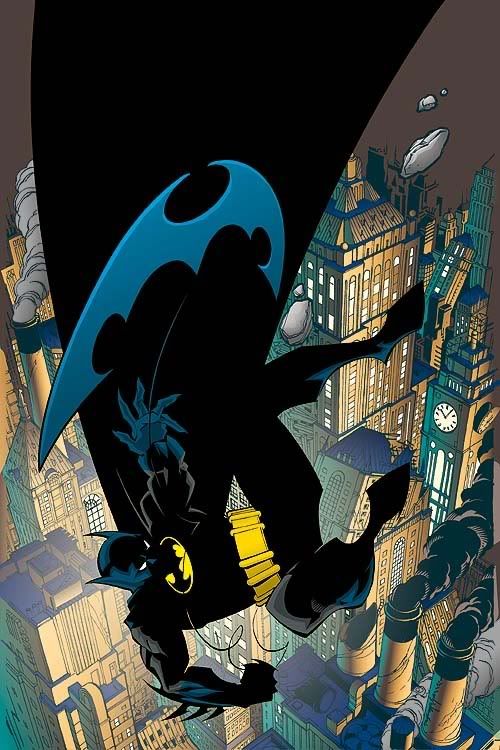 Many people consider it a social faux pas to bore your friends with stories about your dreams. I'm not sure I quite agree with that but I do agree that dreams have a way of seeming a lot more cool to the person who dreamed them than to the audience to whom they are being conveyed.
With that said, a segment of a dream I had last night just seems so darned cool that I feel compelled to share it, so brace yourself.
The background isn't really important. Basically, some unnamed female superheroine with a gun shtick has approached Batman for help. For reasons that weren't entirely clear to me, she needed to infiltrate a circus and she needed Batman's help with an act (which, apparently, they could do in costume... don't ask me why; this isn't the cool part).
So they come up with a kind of trapeze act where they're swinging around while trying to break bottles set up on a platform. First she shoots a few while tumbling through mid-air and then he breaks a few with his batarang until finally there's just a few bottles left.
Finally, he releases her into the air, throws his batarang, which hits and breaks two out of three of the bottles before curving back towards Batman. While the batarang and our heroine are both in flight she throws her gun into the air, the batarang connects with the gun, pulls the trigger and shoots the final bottle, all to immense applause.
Now tell me that wouldn't make an awesome comic-book movie moment!
Tuesday, July 12, 2005
Unstructured Costumes
One of the most eye-catching aspects of superhero comics are the costumes. What would Superman be without his primary ensemble of blue and red? How could batman inspire such criminal dread without his creepy outfit?
Of course, most superhero costumes wouldn't translate well into real life. What's really sad is that all too many don't even work well in their own medium.
Tuesday, March 15, 2005
Unstructured Superdickery
We seem to have a curious relationship with our heroes. On the one hand, we venerate them while, on the other, we desire to bring them down to our own level.
An interesting and amusing exhibit of this latter trait can be found at Superdickery.com which features a collection of comic book covers that "prove" that Superman is, in fact, a dick.
My favorite is a cover with Superman and Jimmy Olsen. Superman is holding up a jacket that Jimmy got him, burning it with his heat-vision. As he's doing this, Superman says, "Jimmy, this gift you got me for Father's Day makes me sorry that I ever adopted you as my son. I'll have to destory it to teach you a lesson!"
The pedant in me does feel compelled to note that comic covers are intended to compell kids to buy their issues and that a common trick is to depict characters behaving contrary to their personas. Never the less, it's a very amusing collection of covers.
Enjoy.
Special thanks to Natalie Ramsey for the link
