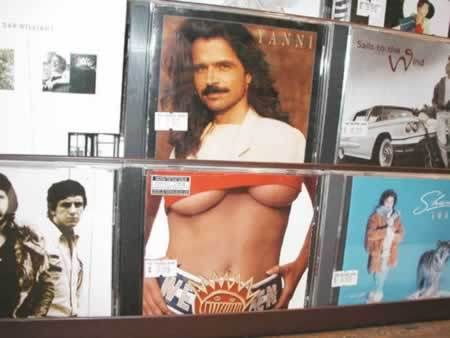
The concert was great.
In case you're in need of an Al fix, here's the video of Trapped in a Drive Thru which is, of course, the parody of R. Kelly's Trapped in a Closet.
A Shaolin temple, in China, is demanding an apology from an internet user who claimed that they were all once beaten by a ninja.
Correct me if I'm wrong, but isn't this the sort of thing that's usually settled with by an elaborately choreographed martial arts showdown?
 If you are a male geek, you probably know how disheartening it is to see that a lot of women prefer guys who are a bit more "conventionally cool". If so, here's an essay by a happy woman who urges her sisters to take a second look at us.
Among other things, she notes that we don't tend to hang out in bars, we're very good at remembering important dates and, lest we seem less than perfectly exciting, we're also very good at sex.
Of course, this does leave the question of how to spread the word. Somehow, I don't think that the internet is going to be the best way to get the word out.
Sometimes the best reply to ugliness is mockery.
Recently Tucker Carlson stated that he and a friend beat up a gay may who was "bothering him" in a bathroom stall -- a admission that was, astonishingly, met with laughter by his television colleagues. One can imagine the sort of outrage that would have been generated if he had said that he had beaten up a black guy or a Jew that had been "bothering" him.
Be that as it may, for all the justifiably angry responses that this has generated, my favorite is a witheringly snarky comment from a Fark forum:
"I can just picture him now, delivering an adorable flurry of overhand punches with his thumbs inside his fists."


Once upon a time, when I was working at mail order company, my brain stumbled between the phrases "Hello, may I help you" and "Hello, may I put you on hold". What actually came out of my mouth was, "Hello, may I hold you?"
Oh, we all know how to say please and thank you and we may even know which side of the plate the knife and the fork go on, but does anyone ever offer any practical ettiquette advice for dealing with the truly awkward situations that life often finds us in? Well, fear not, The Awkwardness Survival Guide is on the case!
The guide offers advice ranging from the embarrassment of using an inappropriate term of endearment with your mother to how to handle your bewilderment when confronted with an ethnic handshake.
Take heart, fellow traveler; help is but a mouse-click away.
I hope that you have been enjoying my series of articles exploring various archetypes. I think that, for the time being at least, I’m going to take a break from the topic (although I would still welcome reader submissions), but I did want to take a moment to talk a bit about the overall topic.
The first thing that I should point out is that I’ve been telling you a lie. By expressing archetypes as a series of factual statements I have implied that a given archetype is something definite and definitive. Worse, I’ve suggested that some characters fit neatly into given archetypes (“He is Jimmy Olsen. He is Bonzo. He is Captain Crunch.”) I have compounded my sin by implying that characters can be an exact representation of an archetype.
In my defense, I have done this precisely because, too often, archetypes are described in such fuzzy terms that I think that they start to lose all meaning. Consider Carol Pearson’s set of twelve heroic archetypes (which includes Innocent, Orphan, Warrior, Destroyer, etc). Her descriptions of these archetypes are, in my opinion, perilously vague. What does it really say about the Orphan to say that his quest is “To regain safety”? I would guess that King Arthur would be an Orphan, but I can’t think of anything about his story that would suggest regaining safety. If it were just Arthur I wouldn’t complain but the same holds true of most orphaned heroes. To be sure, you can force a given hero into the mold (“By fighting crime, Batman's trying to regain the safety of his childhood…”), but such efforts smack of narrative contortionism.
My goal in expressing these archetypes in definitive terms has been to indicate that there is a there over there; that archetypes have a reality and that a given archetype means something, even if the precise meaning is open to interpretation and disputation.
The way that I think of archetypes is to imagine a map of characters. The archetypes would be represented as hills on the topology of the map. Depending on the popularity of the archetype, some hills with be taller – mountains in the terrain – and some of those mountains will have hills of their own or will themselves be part of a range of hills and mountains (the Hero would be such a range). Finding the precise summit of a given hill is difficult, however, because the terrain is complex, with many rills and rifts on every surface.
Because of this, no particular hero is going to be at the summit of his local archetype. Indeed, many heroes will find themselves in the valleys between peaks. Roland the Gunslinger is capable of facing any circumstance and is the master of himself and his surroundings, therefore he’s a Competent Man, but he’s also on a lifelong quest to find the Dark Tower and he’s the social equivalent of a knight in the terms of his own society so he’s also a Paladin. I believe that Roland’s camp is on the side of the valley facing the peak of the Competent Man but others might well disagree.
Characters also evolve. King Arthur starts his life as a Special Boy, but the boy who pulls the Sword from the Stone is not the same person as the man whose body is borne away to Avalon. The trajectory of a character through the archetypal map is every bit as significant as their location on that map at any given point in time. Guinevere’s life progresses from maiden to first love, to wife, to damsel in distress, to adulteress, to penitent. To fit her into a single slot would be to fail to appreciate the tragedy of her story. And even this isn’t a sufficient view. Does knowing that Luke Skywalker takes a hero's journey from orphan to knight tell you everything you know about his character? Of course not. A successful character is more than a few pounds of putty thrown over the scaffolding of his archetype.
I do not, however, want to suggest that archetypes are unimportant. They are a kind of narrative shortcut. When we see a James Bond movie, we can support Bond because we know that he’s the hero. The reason that we can believe that he’s the hero is because we subconsciously recognize that he has characteristics that we associate with the heroic archetype. Imagine what it would be like if every time you read a story you had to puzzle out the nature of every character from scratch. To be sure, a little narrative ambiguity (is this person really a hero?) can be a good thing, but even narrative ambiguity partakes of the short-hand of archetypes by presenting us with conflicting cues. This is also true of stories that subvert the archetype. Such stories rely on our recognition of archetypes to surprise us (“Oh my, it looks like the Sidekick is actually the Hero!”).
Without archetypes, narrative becomes impenetrable, as amply demonstrated by postmodern fiction that seems designed as nothing more than a sadistic effort to frustrate and piss off the reader. Never the less, reliance of archetypes can distort our perception of reality. Historical narratives are particularly vulnerable to false archetypal associations.
For years we thought of Christopher Columbus as the Great Explorer. Later, after the political climate changed, he was recast into the role of the Oppressor. The real person, however, is neither. He was a complex human being who was, by turns, heroic, mercenary, visionary, short sighted, oppressive, brave, and many other things besides, nor is it possible to understand Columbus without understand his world and culture. As it has been said, we are complex and contradictory creatures. When we tell ourselves our history, we should be aware that we want to simplify it; we want the narrative to conform to archetypal stereotypes and our desire for such a narrative will cause us to warp the narrative into a story.
Jung was convinced that archetypes were fundamental clues to the mystery of what is Man. While I have deep reservations about Jung’s psychological theories, to say nothing of his archetypal schema, I suspect that he was not that far off the mark with his intuition: archetypes do say something about us. I think that they may well be mile markers on the road to understanding our human nature.
We are man. We are woman. We are Humanity.
 He is Cthulhu. He is Vulthoom. He is Q'yth-az. He is Hastur, He Who
Must Not Be Named.....
Oh no!
AAAAAAAAAAAAARGHHHHHHH!!!
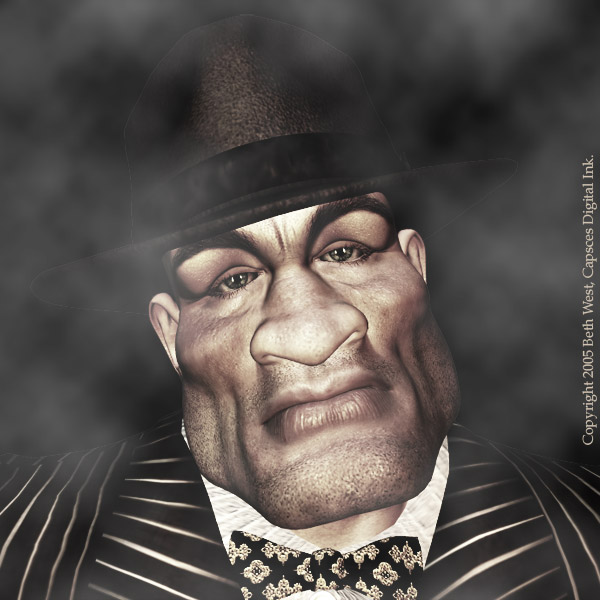
He is the bankrobber. He is the minion. He is the kidnapper. He is the extortionist
The Thug is a man.
Although the Thug shares much of the demeanor of the Brute, he is fundamentally human.
The Thug has a soul, albeit a small one. This means that the Thug can be redeemed, but it is unlikely.
The Thug is not a threat to the Hero. Quite the contrary.
His purpose is demonstrate the prowess of the Hero. He is a paper tiger and a punching bag.
He is nameless. He may be called Bruno, or Boris, or what have you, but these are only labels. In truth, he is a slate.
He is stupid, but he is aware of his stupidity.
He admires the intelligence of the Boss. He despises the intelligence of everyone else.
The Thug wants sex but cannot easily find it. Woman are repelled by him. His only option is force or prostitution. He is a lousy lover.
His moral universe is divided between the weak and the strong. He bullies the weak and cowers before the strong.
He has no history. He was not born, nor does he have a family. When he is killed, he will be unmourned.
He is vicious but not Evil. He lacks the intelligence to be Evil. He is, however, drawn to Evil as a moth to a flame.
He is a willing thrall. A slave. He freely subordinates his will to that of the Boss.
He has a dim but determined sense of loyalty. It is a loyalty predicated on fear and worship.
The Thug has no taste. He wears cheap suits, he smokes cheap cigars and he drinks cheap beer. To the extent that he has any relationship with women, they too are cheap.
If he wasn’t a bully, he would be pitied. On a deep level, he knows this. That is why he bullies.
The Thug has no God except for the Boss. The Boss is a wrathful God.