Well, I thought that a long weekend would be the perfect respite for the writing of an essay. Alas, Santa's evil brother, Nackles, decided to deliver me an early present in the form of a kidney stone which means that my weekend is consisting of interludes of pain interspersed with interludes of Percocet-induced sleep.
At least I was able to enjoy a good Thanksgiving dinner before it struck.
I do want to clarify that I have no immediate plans to finish up part two of the Intelligent Design essay. Frankly, I've lost my train of thought on it and would rather not deliver a substandard conclusion simply for the sake of concluding it.
Saturday, November 26, 2005
Of Mice and Kidney Stones

Friday, November 18, 2005
Unstructured Fun

 First an announcement: instead of doing regular Tuesday Fun articles, I've decided to do them on a less structured scheduled; hence, "Tuesday Fun" is now "Unstructured Fun".
For this first entry, Lore Sjöberg, formerly of Brunching Shuttlecocks, has put together a fun little web toy called Untitled States. Basically it's a set of pictures that you can self-caption.
It's a simple toy but, in my opinion, surprisingly fun to play around with. It also provides you with HTML so that you can add the resulting images to a web page or post them to a forum.
Have fun.
Thursday, November 17, 2005
Life Before Death

There are
Those zombies among us
Who purport to believe
In life before death.
I will not argue with them.
Suffice it to say
That we are certain
That it is the dead who walk,
That it is the dead who talk,
And that no one knows a thing
About what came before.
Photo courtesy of Anthéaïs
Wednesday, November 09, 2005
Immoliation

I sketch my future
From strewn embers
As I gather myself to myself
My vision blazes through
Imponderable eventualities
I see myself casting brightness
From a self-fueled pyre
I burn myself, again,
Consumed by hope.
Photo courtesy of Meganpru
Sunday, November 06, 2005
The Eschatologist
It's Monday. At precisely 7:16 in the morning, Eastern Daylight Time, the world ends. It does that a lot on Mondays.
It's a standard Christian apocalypse which means a long morning for me. It used to be that these things would just be a couple of days of plague, famine, et al, followed by a nice, neat Heavenly ascension and Judgment — hallelujah! Ever since the fundies polluted the zeitgeist, they've invariably included a tedious thousand-year reign of the Antichrist in which every last little tidbit of biblical hallucigenia gets played out in endless, banal variety.
If there's one thing I can't stand, it's a drawn out eschatology. That's why I love the techno-nerds. When they end the world it's usually something like some rogue grey goo that escapes from a secret lab — there's always a secret lab — that eats the world in three days, or some super-virus that makes everyone puke their innards up in a week, or an accidental black hole that devours the planet before lunch.
At 10:28 its zombies. Fucking horror freaks.
At 1:10, 1:31 and 1:56 we get Hindu, Islamic and, so help me, Mayan endings. This is why I drink.
I get a nice break before there's a nuclear holocaust at sundown. I haven't seen one of those since 1998. I actually like the nuke scenarios, at least when they don't have any damned mutant cannibal hoards. Nuclear wars are all pretty fireworks followed by a pleasant nuclear winter as mankind's dominion over the world comes to an end. They're also easy to clean up
Elder Gods at eight, war against the machines at nine, everything's a dream and the Dreamer is now waking up at ten and, finally, aliens destroy the planet at a quarter to midnight.
I was twelve years old when I got my gnosis. It was May of 1958. Most of the apocalypses back then were of the nuclear variety but this time it was giant bugs. Of course I didn't know anything about the ways that the world ends, back then. I was twelve and, as far as I was concerned, everything was ending for the first time ever.
The bugs in question were locusts. It was a standard horror movie. They came out of the Alamogordo but, in no time flat, they were everywhere.
I was a smart kid, a nearly perfect stereotype of a 50's science geek. I even, swear to The Great Unknown, had a junior chemistry set, a backyard telescope and, yes, a slide rule and a pocket protector. I knew that the bugs just didn't make any sense. Giant bugs violate the laws of physics and biology. They should have collapsed under their own weight, exoskeletons cracking from the strain. They shouldn't have been able to breath. The sure as hell shouldn't have been able to fly.
I remember being trapped in school, looking out at the street where the locust were ripping open cars and tearing apart pedestrians, and it just didn't make any sense, so I stopped believing in it. That's when things got weird.
You ever have a dream and you wake up just enough to know that it's not making sense but not enough to realize that you're actually dreaming? It was like that. Time suddenly got jumpy as my mind tried to force what was happening into some kind of semi-sensible template. The bugs flickered and were replaced by insectile robots. Then they flickered back. Everything jerked and then I realized that the bugs were really aliens. Hugh saucers floated in the afternoon sky. Then the disks crashed to the ground and the bugs went back to being bugs. The world lurched and, instead of bugs, they were Commie tanks cleverly disguised as bugs. Then they went back to being bugs again.
I don't know how long this went on. Time didn't make sense. All I knew is that there was no well in hell that overgrown locusts were destroying the world and that I was not going to let that be the case. Eventually a hand clasped my shoulder and some guy I didn't know said, "Kid, what the hell do you think you're doing?"
I turned around. He was a tall, muscular guy with a weirdly feminine look, especially around his eyes.
I remember stammering that none of this made any sense. He smiled and told me that I had to relax and let it play itself out. He told me that I couldn't force it. I had no idea what "it" was supposed to be. He touched my forehead and everything went hazy.
Tuesday is a trifecta of ecological, economic and epistemological collapses, which is not a bad day as these things go.
I woke up in my own bed. I got up and ran to the living room in a panic. I remember my mom being very cross with me. She told me to march back into my bedroom and put some clothes on because, "We're not animals!"
I knew better than to ask about rampaging radioactive monstrosities. Clearly it had, after all, been a dream even though it seemed far too vivid to be one. It was Saturday (so what the hell happened to Friday?) and I desperately needed to clear out my head, so I told my folks that I was going to the park.
When I got there, I found myself lost in thought. I think that I'd finally managed to convince myself that I'd imagined everything when, off in the distance, an air raid siren went off.
"Don't panic."
There he was, again: the same big frame, the same feminine eyes. I don't mind telling you that he really creeped me out.
"Who are you," I demanded. "What's going on?"
He said that, from the sounds of it, we were about to experience a nuclear war. I could feel my legs going rubbery. Giant bugs, no way, but a nuclear war was something that I could, in fact, believe in. I wondered how soon it would be before the soviet bombers dropped their awful cargo on us.
"My name is Elaios," he told me, "I'm the archon of the North American continent. You can call me El."
I had no idea what he was talking about. All I knew was that I was about to die. It must have shown on my face.
"Look, kid, this isn't any more — or less — real that what happened yesterday. The world's about to end, but that's nothing to worry about. It does it all the time."
Wednesday is sci-fi day: comets, gamma ray bursts, a planet busting anti-matter explosion (from a secret lab), and the Borg.
The world has been coming to an end since the beginning. I'm told that, in the first fractions of a femtosecond after its creation, the universe collapsed back on itself, or expanded out into a thin haze of nothingness, more times that can be counted. Even when the expansion was just right there were other things that went wrong. Sometimes there was too much gravity and everything collapsed into black holes. Other times the strong force was a bit too weak and we ended up with a universe that only had hydrogen. Lots of things could, and did, go wrong. Apparently it took a fair amount of tuning just to get something stable enough to allow for the existence of people.
Once we were on the scene, things really got out of hand.
The world doesn't end on Thursday. The world never ends on Thursday. Don't ask me why. I'm just glad that I get a regular day off.
An A-bomb went off less than half a block away. I was instantly flashed into atoms as was "call me El". It's a painless way to die, which is another reason why I like nuclear wars.
I suppose that I should have been more surprised to still have any sense of awareness, but I assumed that I was a ghost and that I'd be going up to Heaven soon. I was, however, surprised at how solid I felt and at how solid Elaios looked. He knelt down to my eye level and asked me, "Do you wonder why the world doesn't ever seem to completely fall apart?"
The highlight of Friday was a rampaging queer hoard running around buggering, burning and applying forced makeovers to unwilling straight guys. When you've seen as many rampaging hoards as I have you appreciate the fine details that illuminate the specific angsts that generate them.
Awareness changes reality. I suppose that there's some deep quantum explanation to account for this but it's been decades since I lost my simple faith in the explanatory power of science. All I know is that it's so.
The very first intelligence was the Demiurge. He's El's boss, which makes him my boss's boss. In the beginning, he touched the spark that ignited the universe and has been spending the rest of Time doing his best to make sure that that precious, divine flickering, which is our Cosmos, doesn't fade. Or so El says. Some folks who've heard about him think that he's a godly semi-abortion who created this universe to trap us in a world of lies and illusions. Whatever.
The important thing is that we're all bending reality to our expectations. If you want to put some kind of postmodernist or New Age spin on that, be my guest. What matters is that, most of the time, our competing desires to remake the universe into our own images cancels out. The Demiurge is the tie-breaker. It prefers a universe of orderly physical laws, which is what we mostly get. Frankly, that works for me, too.
The problem is that reality just isn't very stable. People are pessimistic. They look out at the universe and some deep part of them thinks that it's all just a little good to be true. That doubt translates into eschatology. Sometimes — often — the balance tips and the world goes spiraling down into one of a million different oblivions.
Saturday starts with run away global warming and ends with an endless ice age. The irony fails to amuse me.
"You ever hear the story of the virtuous men?"
I shook my head.
"It's a story that you find in a lot of mythologies. Supposedly there are a handful of virtuous men — sometimes seven, sometimes nine, or some other mystically significant number — whose virtue prevents the world from ending."
Off in the distance I could see blasted buildings. Every so often there'd be a flash on the horizon that I assumed was another bomb going off. I toyed with a chunk of fused glass that I had pulled from the ground.
"I suppose that you're going to tell me that you're one of those guys, right?"
He smiled. "No. I'm not particularly virtuous and the world keeps ending whether I like it or not. I'm just one of the guys who gets to put it back together after it falls apart."
It's Sunday. Aside from a lone AI gaining godlike intelligence and turning the whole solar system into computronium, it's been a quiet morning.
I'm having coffee with El. I've been the sub-archon in charge of the Eastern Seaboard for almost five decades now.
"What's the point, El?"
I'm tired. I'm tired of living through catastrophe after catastrophe. I'm tired of getting murdered. I'm tired of being blown to smithereens. I'm tired of being butchered, raped, dismembered and eaten. I'm tired of being sucked into black holes and tired of living through every inane nihilistic fantasy that the Collective Unconscious spews out.
I'm tired of fixing everyone else's mess.
He absently taps his mug with his spoon a few times. It's just one a dozen annoying habits that he has.
"What I can I tell you, kid? I've been doing this since King Tut was in diapers and I've thought about calling it quits thousands of times. I never do, though."
He shrugs. "I know it sounds corny, but I believe in the world. I believe in humanity."
I tell him that I can't do it anymore, that I just want to end it all, even if that means ending myself. I tell him that I've got a gun at home with a bullet in the chamber. I tell him that I just wanted to say goodbye and that he's going to need to find someone else to manage this little corner of our fragile world. I've got my own eschatology to take care of.
He tells me that I just need a vacation. He leans over and takes my gnosis. I had no idea that he could do that.
It's Monday, again. I've got the hangover from Hell. I clutch my head, trying not to puke. I can tell it's going to be one of those days.
At least it's not the end of the world.
Friday, November 04, 2005
State of the Blog Update
As promised, I will be starting up the blog soon. I'm giving some thought to how I want to do so. I'm still a bit worried about just how much time I'm going to have to dedicate to it and whether or not I should, in fact, make it just a bit more unstructured. I think that I will go back to doing regular poetry postings every Thursday. I'm not entirely sure if I want to keep Tuesday Fun as a regular feature or just go to posting fun stuff as it comes on an irregular basis. The Sunday posts are the most up in the air. I like writing essays but I don't want to reach the point of writing an essay for the sake or writing one. I'm also thinking that I'd like to do more reviews and stories (in fact, this Sunday I will have a fresh story up).
In the meanwhile, he's a pic of the costume I wore this Halloween. Please note that the tonsure (i.e., "monk's cut") is not a wig.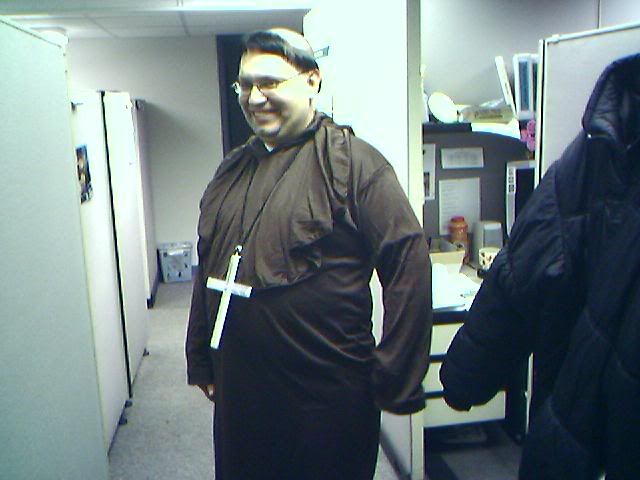
Sunday, October 16, 2005
Status
In spite of the fact that I plainly said that I wouldn't be writing anything until November, I can see that some of you have been peeking in anyway, so I may as well let everyone know that I have made the move to my new place and that I've settled in quite comfortably.
This is the first time in my life that I've had a place entirely to myself and I'm finding that I rather like the solitude of living alone. I think that I have a bit of a hermetic streak in me.
This is not to say that the move has been without complications. I only now have managed to get my broadband in and, even then, only at the compromise of having a long cable snaking from the living room to where my computer actually resides. Adelphia has gotten very stubborn about installing additional outlets in apartments (and my apartment management hasn't been as helpful as I'd like in communicating the fact that yes, I have authorization, dammit!). In like manner, I've been patiently waiting for the complex to install a dish so that I can watch TV... although being without for the last sixteen days has proven that it's not as invaluable a service as I might have supposed (and thank goodness for Netflix).
So, in summary, all is well and good and I look forward to returning to our regularly scheduled blog early next month. Please do stay tuned.
Thursday, September 08, 2005
An Announcement
If my work load wasn't enough (although levened by a recent raise), it would seem that my relationship with my girlfriend is now at an end. Please be assured that this is an amicable breakup and it is, I believe, truly for the best for both of us. Never the less, it does put me in the situation of finding a new place to live (followed by the inevitable nuisance of moving and getting settled in).
The bottom line is that I'm not going to have any time to blog for quite some time. I feel bad because last week's essay left on a cliffhanging note. Never the less, I'm not going to try to compromise with a half-assed effort to write when I have neither the time nor the focus to do so. Sorry.
The blog will be on hiatus until November. I suspect that a lot of my semi-occasional readers will be saying their final parting, and I can't blame you if you do. Never the less, I do hope that you'll be checking back in when I return. In the meanwhile, take care.
Tuesday, September 06, 2005
Bongard
I wsa introduced to the world of Bongard problems by Douglas R. Hofstadter's book Godel, Escher, Bach: an Eternal Golden Braid. Bongard problems are studies in pattern recognition and are, thus, useful to such researchers as neurologists and psychologists as well as those studying artificial intelligence.
A Bongard problem is a set of twelve squares — six on the left, six on the right — with figures in them. The left group of figures have some property that links them while the right group lacks that property. The challenge is to identify the property. In the example below, the property is three sidedness. The potential properties cover a wide range, including color, size, curvatures, angles, and so forth. Many of the problems are exceptionally subtle and can be a real challenged to figure out.
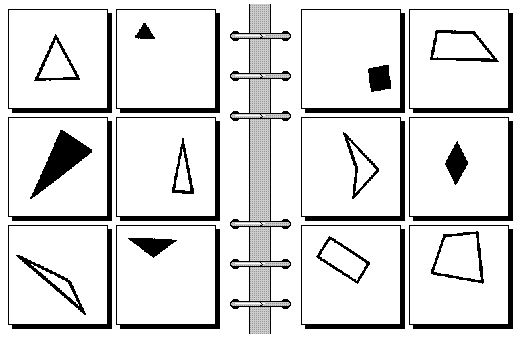
Harry Foundalis has put together an index of 263 (as of this writing) problems, which constitute today's link. Be warned, these are Bongard problems. No solutions are provided; you will need to work those out on your own. The nice thing abount these, though, is that once you've found a solution, it's usually self-evident that you have the correct answer.
Monday, September 05, 2005
A Brief Word on Hurrican Katrina
It has been said that civilization is only ever three meals away from anarchy. Katrina is only the latest in a long seriest of demonstrations of this principle with its antecededents stretching back into prehistory. As such, I am neither shocked nor surprised at the looting or the general lawlessness that have followed in its wake. What does impress me are the stories of compassion, heroism and humanity that have arisen in blatant contradiction to this rule.
It is in disaster that we often see the worst that humanity has to offer. It is also, then, that we often see the best. Always, we have a choice in our actions, even when the world is falling to ruin around us. I can only hope that, if I ever find myself is such circumstances, I will be able to rise to the occasion as well.
Saturday, September 03, 2005
More on Intelligent Design, part I
It would seem that my off-site essay link to Jon Carroll's essay on the topic of Intelligent Design (henceforth ID", in which he argues that it has no place in a scientific course of study, particularly in the context of a public school's science classes, has generated a rather unusual amount of traffic. In addition to the posted comments, I got a fair share of email.
Much of the communication that I received was a dull iteration of the sort's of arguments that have been used in attempts to defend Creationism (or to attack Darwinism) ever since the publication of The Origin of Species. Few people actually addressed the issue of the theory of ID, which more or less what I expected given that it is my belief that most proponents of ID aren't really interested in it except in as much as it provides a back door for standard Creationism. One person, whom I shall not name, asked what I thought was a more pertinent and intelligent question — she wanted to know what, exactly, ID wasn't science.
[Science] is observation, formulation of an hypothesis, using that hypothesis to make predictions (ie, that there are as yet other undiscovered systems which can't be accounted for under existing evolutionary theory), etc. I know it's a gussied up "goddidit", but I can't see how that precludes it from being science, even if it's wrong.I think that this is a fair question and I think that it deserves an answer. In addressing it I want to be clear that I am, specifically, addressing the Behe version of the ID argument. It is necessary to specify this since there are quite a lot of variations of ID with some being more overtly theological than others. The version supported by William Dembski, for instance, explicitly conjectures not only a hypothetical designer but, in fact, that the supposed designer is none other than the Christian God. Since science does not address anything outside of the natural world, any theory that appeals to the supernatural is not, by definition, science. Other ID variants are less explicit in their endorsement of supernatural agencies; however, it would be impossible for me to address every variant of the theory. The Behe version is the most famous and, I believe, the one that comes the closest to approaching scientific standards, therefore, I will be limited my discussion of the subject to it.
I want to also make it clear that what is being proposed for the schools is not the Behe version of the theory. I think that it is important that we not lose sight of this. The question of whether ID could be considered scientific is distinct from the question of whether it should be taught in public classrooms. Unfortunately, in the current political climate, one cannot really address the question of the scientific metrics ID without addressing that other question, although I will address the question of its scientific merits before returning the secondary issue of its appropriateness for students.
I think that we must first clearly define what Behe's hypothesis is. In Darwin's Black Book Behe raised the following conjecture: certain systems in the biological world can not be accounted for via evolutionary processes; it is, therefore, rational to conclude that those features are the product of an external intelligence. He proposed that the distinguishing feature of these systems was a property called irreducible complexity (henceforth IC and ICS for irreducible complexity and irreducibly complex system). An ICS is a system that is composed in such a way that one cannot remove any component of the system without breaking it.
The typical analogy of an ICS is a mousetrap. Behe, himself, uses this example in his book. He says that a spring-loaded mousetrap is an ICS because one can not remove, for instance, catch. Behe claims that the same sort of irreducibility is found in certain natural systems such as the flagella of the E. coli bacteria.
Before I go any further, I want to contrast ID with an early 19th century argument for the existence of God known as "Paley's Watchmaker". This was an argument put forth by the philosopher William Paley (although variants go back at least as far as the roman philosopher Cicero). A typical version of the watchmaker argument asks us to imagine that we are walking along a trail when we come across a watch (imagine an old-fashioned pocket watch with lots of intricate gears). As we examine the watch we are impressed by its complexity. That same complexity tells us that the watch isn't something that just happened to form by natural processes; it was constructed. The fact that it was constructed implies the existence of a constructor, i.e. a watchmaker. Paley argues that the fact that the complexity of the watch implies a designer must also imply that the complexity of nature requires one as well.
Paley's argument has a great deal of intuitive appeal. Indeed, among the people impressed by it was none other than Charles Darwin, who believed, as a young man, that the argument did, in fact, demonstrate the existence of a god (if not, indeed, God himself). The argument is, however, fundamentally flawed. The particular flaw is a type that philosophers often call begging the question. A question is begged when the answer provided is circular. In this case, Paley uses the complex nature of the watch to argue that it is an artifact, which is to say the creation of artifice — which is to say that it is not a product of nature. However, he then uses the artificial complexity of the watch to argue that biological objects must also be products of artifice. In other words the aspect of the watch that he's contrasting with the natural world is being used to draw a conclusion about the natural world.
A more reasonable conclusion is that our observation that natural structures exhibit complexity means that the mere complexity of the watch is not, in and of itself, sufficient for us to draw the conclusion that the watch has a watchmaker. There are other factors that lead us to the rational conclusion that it had a maker, not least being the fact that we have experience with watches and with biological systems and that we know that the creation of one (by construction) is not like the creation of the other (by germination and growth). The conclusion that Paley reaches is not justified by the observation.
Paley's watchmaker had a lot of pull beyond its logical merits simply because no one had any alternative idea of how biological complexity could, ultimately, be accounted for. Ultimately it was Darwin — older, wiser, and with the benefit of his observations in the Galapagos — who showed how that very thing could happen without requiring us to suppose an intelligent agency (Richard Dawkins has referred to the agency of natural selection as a blind watchmaker in a jab at Paley's original argument). Darwin did more than simply offering an explanatory framework that allowed us to see past Paley, he demonstrated the danger of reaching a conclusion based solely on the lack of a compelling alternative.
Although Behe's designer has much in common with Paley's watchmaker (indeed, it is a philosophical descendant), Behe's arguments are more subtle and don't suffer from the specific logical flaw that Paley fell prey to. Behe isn't drawing a direct comparison between artificial and natural system; rather, he is making a comparison between one type of natural system and another.
Both detractors and supporters of ID often fail to realize that Behe does not deny the existence of natural selection. In point of fact, Behe believes that the majority of structures in the natural world, including the existence of ecosystems with diverse species, can and must be accounted for my conventional Darwinism. It is not even entirely clear that Behe is a creationist since he doesn't offer any opinion about the origin of life. Behe's proposed designer is deliberately left vague as are the mechanisms whereby it (or they) implemented the designs that Behe believes require an intelligent agent to account for. Behe's designer could well be aliens who visited the earth back in the pre-Cambrian and who performed acts of genetic engineering on the local microfauna. Indeed, if the theory is to have any scientific merit, it must limit its speculations to the natural world.
Religious critics of science believe that the fact that science doesn't allow for supernatural speculations means that science is, at its heart, anti-theistic. This is an error. Science is, basically, an epistemological philosophy about the natural world. Science only addresses questions about the natural world by design. At the point where science entertains non-natural explanations it finds itself in the situation illustrated by a semi-famous Sydney Harris cartoon where two scientists are pondering a chalkboard full of equations. In the middle of the equations in the phrase "and then a miracle occurs". While it may be easier to suppose the existence of miracles, once we have done so, we have abandoned science for metaphysics.
Behe, to his credit, does not claim that irreducible structures are miraculous. He only claims that they are the product of intelligence. The intuitive implication is, of course, that there is something miraculous, indeed divine, going on, and I strongly suspect that Behe is being disingenuous when he coyly claims that people are jumping to conclusions, but a theory can not be dismissed simply because it implies something that's non-scientific, no matter how strong that implication may be.
A stronger criticism is that Behe is drawing a conclusion from an absence of evidence. Even if we grant the claim that current Darwinian theory can not account for an E. coli flagellum, are we required to conclude that the explanation must be an external intelligence? Before we evaluate this criticism, I think that it would be a good idea to consider a case where an observational absence led to a legitimate scientific conclusion.
A neutrino is a kind of massless (or near-masslesss, perhaps) particle that has nearly no interactions with other particles. A typical neutrino could pass through several light-years worth of solid lead before it was stopped. They have been described as being as close as it is possible to get to nothing while, never the less, still being something.
Neutrinos were originally postulated by Wolfgang Pauli to account for some missing energy and angular momentum during a processes known as beta decay. Neutrinos were not being observed during this type of decay. Indeed, because of their extremely non-interactive nature, it would take another quarter of a century before experimental evidence for the existence of neutrinos was produced. In the meanwhile, physicists contended themselves with a hypothesis whose sole rationale was to account for a discrepancy in the data.
So, how is this different from ID and IC? Well, for a start, physicists didn't just pull the neutrino out of their asses (although that would be a neat trick!). The basis for conjecturing the neutrino were two of the conservation laws: the conservation of mass and the conservation of angular momentum. It is not an exaggeration to say that these laws form an important part of the foundation of modern physics. They are philosophically important to physics since the idea of conservation provides a basis from which we can make speculations involving an invariant physical reality. If any of these laws did not hold, not only would we need to radically reevaluate our understanding of physics, we'd have to reevaluate our basis for deriving models of physical law in the first place.
Beyond the epistemological question, the laws of conservation have a firm grounding in experiment. Literal centuries of effort have found nothing which would lead us to suppose that the conservations do not hold. The most radical change to theory was provided by Einstein who showed that the conservation of mass and the conservation of energy were, in fact, both aspects of a single conservation law which allowed for mass and energy to change form from one state to the other (which is what allows the Sun to burn and nuclear bombs to go boom).
Faced with a single observation that seemed to show a violation of two conservations, Pauli decided that, given they overall success and importance, it was much more likely that something else was going on. The simplest supposition was that there was an unobserved particle. Such a weakly interacting particle would be a bit weird, but certainly not outlandish. His intuitions were validated by the eventual detection of neutrinos, which is now done on a regular and ongoing basis.
Many counter-intuitive theories follow a similar course. Astronomers are positive that there is dark matter in the universe because, otherwise, their observations of such things as galactic rotations simply don't make sense. These hypotheses are arrived at out of necessity and are based upon the application of known law (e.g., the Newtonian laws of gravity) in order to be arrived at.
How then is this different from ID?
I will take that up in next week's continuation of this essay (assuming, of course, that work concerns don't delay it).
Thursday, September 01, 2005
The Persistence of Evil
Left to my own devices,
I am an engine of atrocity.
My idle fingers
Keep getting tangled in politics
And before I know it,
There’s been another genocide.
It’s not that I try,
It’s that I don’t,
And destruction
Follows in my wake.
I just can’t seem to kill time
Without committing crimes
Against the whole of humanity.
My wife tells me
That I should get a hobby
Before I accidentally fill
Any more mass graves.
I tell her
Maybe tomorrow.
Photo courtesy of zu.browka
Tuesday, August 30, 2005
Unstructured Engrish
Japanese pop culture has an interest in English words that's rather analogous to certain westerner's interest in getting Japanese tattoos, which is to say that the coolness of the shapes is often more important than the actual meaning.
This, of course, leads to quite a lot of inadvertant humor on either side. Since this is an English site, I will, perhaps unfairly, highlight the Japanese side of that equation by pointing you to Engrish.com which is a photographic collection of English-like oddities that have been found in Japan.
While it would have been easy to make a site like this with a cruel underlying sense of mockery, I think you'll find that Engrish.com is a good-natured site whose only goal is a bit of gentle humor at the sort of garbling that naturally occurs when cultures mix.
Friday, August 26, 2005
Suggestions, Please
As you all know, I've been posting audio links to my poems. I've been recording these over the phone via Audioblogger and the quality is rather lacking, so say nothing of the fact that I've been getting tired of having them cut me off in mid-composition.
I decided to experiment with recording directly to my PC using a trial of an MP3 recorder and the quality is absolutely amazing. The problem is that I that I need to find a free site that I can use to upload them to so that I can link to them. Does anyone know of such a site?
Wednesday, August 24, 2005
Torture

I am not a tortured soul.
I do not rage against the very heavens.
Perhaps I grumble and mutter,
And speak ill whispers
And sometimes wish
That the very stars would fall,
But I do not rage.
My bones do not heave
My very flesh
And press forlorn sighs
From my lungs,
Except sometimes
In the morning,
Or at night
Or, occasionally,
Throughout the day.
Just not every day.
Nor do I ever long to die
Except for once in a long while
When it seems that,
With every single step
Into this ceaseless, heartless wind
I am winding my way around
The coils of a noose.
I am happy,
Mostly happy,
Almost certainly happy,
Except when I’m not.
Photo courtesy of Sandeep Thukral
Subscribe to:
Posts (Atom)
