Like most people, I tend to think of graffiti as an eyesore. I will admit that there is some small fraction that aspires to art but most of it is banal. For archaeologists, however, graffiti can be an invaluable tool for understanding the common language and culture of a vanished people.
Today's link is a list of gaffitos found at Pompeii.
There are declarations of love ("I don’t want to sell my husband, not for all the gold in the world"), of hate ("Serena hates Isidorus"), and of bitterness ("I want to break Venus’ ribs with clubs and cripple the goddess’ loins. If she can strike through my soft chest, then why can’t I smash her head with a club?"). There are sexual boasts ("Floronius, privileged soldier of the 7th legion, was here. The women did not know of his presence. Only six women came to know, too few for such a stallion"), insults("Chie, I hope your hemorrhoids rub together so much that they hurt worse than when they every have before!"), and compliments("Crescens is sweet and charming"). There are philosophical proclamations ("Once you are dead, you are nothing"). There are advertisements ("Palmyra, the thirst-quencher") and admonishments ("heophilus, don’t perform oral sex on girls against the city wall like a dog"). There are some that sound like a something out of LiveJournal ("On April 19th, I made bread").
There are also the critics: "O walls, you have held up so much tedious graffiti that I am amazed that you have not already collapsed in ruin."
The overall impression is that there were ordinary people just like ourselves, although every so often you come across an entry that's jarring to our modern sensabilities ("Take hold of your servant girl whenever you want to; it’s your right"). On the whole it is a fascinating glimpse into the lives of those who were beneath the notice of History, as are most of us.
Wednesday, December 14, 2005
Graffiti

Tuesday, December 13, 2005
PSA: Pump and Dump Stock Trading
Lately I've been getting a lot of spam with unsolicited hot stock tips. According to a recent AP article, similar messages are getting sent out via text messaging to cell phones and IM accounts.
These are all a type of scam known as "pump and dump" trading. What the scammers do is they buy up a bunch of low valued stock, then they spam out messages encouraging people to buy the stock because it's a hot pick. Once enough people buy into the stock, the scammers sell their own shares for a profit. Meanwhile, the people who were tricked into trading typically lose money when the stock price collapses back to its regular value.
It should go without saying that it's never wise to respond to unsolicited messages but, sadly, many people still do. Like any other unsolicited email or message, just delete them without giving them a second glance.
Unstructured Foam
 Marshall McLuhan once famously proclaimed that the medium is the message. I leave it up to you to decide what sort of message is conveyed when the medium is the foam in a latte.
Sunday, December 11, 2005
On the Problem of Celestial Bodies in the Land of the Lost, part I
Back in the early to mid 70's, Sid and Marty Krofft were a dominant force in Saturday morning kids programming. Mind you, this is equivalent to saying that you’re the tallest person at a dwarf convention. In those days, kids shows were done on the cheap and were largely considered an afterthought by the Networks — a way to provide a convenient slot for toy manufacturers to hawk their wares.
The Kroffts specialized in low-budget live action shows. Most of the shows were fairly dismal with such titles as Lidsville (a show about a land of living hats, which must have been inspired by LSD consumption), Electra Woman and Dyna Girl, The Bugaloos, and similar dreck. There did exist one bright spot in their lineup: a show called Land of the Lost.
Land of the Lost was about the adventures of the Marshall family who were stranded, Robinson Caruso style, in a mysterious and strange world. The most obvious thing about the show (aside from its lack of budget and the dearth of good acting) was that it had dinosaurs (provided via stop animation as well as some truly pathetic puppets for close-ups). Indeed, from interviews with the Kroffts, it's clear that all they were interested in was plugging into the dinosaur market which, even in those pre-Jurassic Park days, had a hell of a lot of kid appeal. Left to their own devices, they would have probably come up with one of their standard crapfests. Fortunately, they were lucky enough to sign up David Gerrold as the story editor.
If the name tickles your hindbrain, it may because you've seen him credited for the much loved Star Trek episode The Trouble with Tribbles. Gerrold, by that point, had quite a few science fiction screen credits. More importantly, he was a bonified science fiction author in his own right (I would absolutely recommend his book The Man who Folded Himself, which is, in my opinion, the very best time travel story yet written). Even more importantly than that, he was well connected in the serious science fiction community and, thus, able to get such respected authors as Larry Niven, Theodore Sturgeon and Ben Bova to contribute stories. From the perspective of the Kroffts, this was like knowing someone who could get Stephen Hawking to help you with your physics homework.
I started watching the show when I was five years old. My initial attraction to the show was, of course, the dinosaurs. Even compared to other little boys, I was intensely interested in dinosaurs. I remember shouting out "That's a struthiomimus!" in Kindergarten when the teacher was showing us dino pictures. By the time I was six, half my vocabulary had an alarmingly high percentage of complex Latin and Greek names. Ultimately, though, it wasn't the dinosaurs that made me really love the show. What really kept me coming back for the full three years was the originality of the world that the Marshalls had found themselves in.
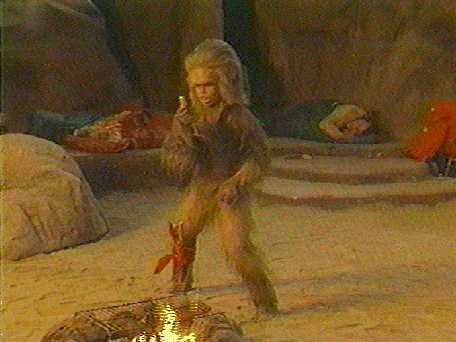
I suspect that most people, given the assignment of making a dinosaur show would have either set it in the past (via time travel) or would have done something in the present using some kind of Jurassic Park variant. Gerrold, in conjunction with Niven, came up with something really out of the box. The story was set in an entirely different universe. Erratic space-time doors would occasionally trap random people and beast in this other universe (hence the dinosaurs, as well as other curious flora and fauna, including a family of ape-like creatures called Pakuni1). The universe also had its natives in the form of the Sleestak who were a kind of hybrid insect/lizard people who were the degenerate descendants of the creators of the Land of the Lost.
The most interesting thing, for me, however was the nature of the universe. Rather than being a true world, the Land was actually a very small pocket universe that wrapped around itself. An early episode (by Larry Niven) has the Marshalls attempt to find their way to civilization by sailing down a river. At the end of the episode the river returns them to their starting point. A later episode has them on a mountain top looking through a pair of binoculars and seeing the backs of their own heads in the distance. Even as a kind, that scene simply blew me away with the awesomeness of its implications.
As a kid, of course, I didn't really understand what was being presented. I thought that it was cool and mind blowing, but I didn't realize that I was being exposed to the idea of higher geometries.
Allow me a slight digression to discuss this.
We tend to think of such concepts as the forth dimension as being thoroughly modern. In point of fact, the idea goes back some ways. One of the best treatments of the subject comes from Edwin Abbott's book Flatland. Flatland is a universe of two dimensional creatures (who mainly take the shape of simple polygons). Being constrained to a two dimensional plane, they have no concept of the third dimension. The protagonist of the story, a Mr. A Square, encounters a visitor from the 3rd dimension. This visitor, who is a sphere, demonstrates the existence of a third dimension beyond the two that Mr. Square can perceive. In the end, A Square ends up afoul of the authorities, who consider his claims to be anarchic and blasphemous. He also offends the sphere by suggesting the existence of dimensions beyond the third.
Flatland was simultaneously a parody of Victorian culture (a fact that gets lost of some of its detractors who object to the portrayal of women in the book) as well as a kind of theological speculation. At the time of its writing, some theologians and spiritualists believed that Heaven and Hell could be found in the fourth dimension (which is much more tenable than supposing that they can be found somewhere in our universe) and that angels and demons were able to accomplish their apparently magical interactions with the world via their privileged status of being four dimensional beings.
In the early part of the 20th century, Albert Einstein brought the idea of higher dimensions to the world of physics. Einstein proposed that space and time were a unified four-dimensional structure and that both are curved, in higher dimensions, by the presence of mass. With the ascendance of Relativity, the subject of higher dimensions ceased to be a theological parlor game.
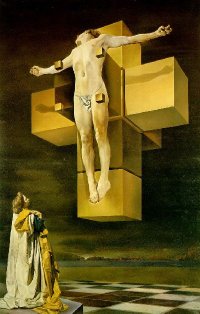
With the emergence of science fiction, as a distinct genre, in the late 20s and early 30s, it wasn't long before the subject became the subject of popular fiction. One of the more memorable of the early efforts was Heinlein's And He Built a Crooked House which was about a man who built a house in the shape of a "flattened" hyper-cube (aka, a tesseract). Think of unfolding a cube and flattening it out and you have the basic analogy (for what it's worth, a "flattened" tesseract looks like a cross built of cubes with additional cubes struck in the front and back of the junction point). In the story and earthquake causes the house to fold up into a true tesseract, causing immense distress to the people trapped inside of it.
Although you find references to the fourth (and higher) dimensions in stories from the Golden Age of science fiction (which lasted through the 50s), it wasn't really that common of an idea. The bread and butter of the science fiction community were stories with spaceships and aliens (and scantily clad women in constant distress, to judge from the covers of the pulp magazines).
The late 60s and 70s represented a sea change in the SF community. So-called New Wave authors rejected the traditional tropes of science fiction in favor of more literary stories where the science fictional elements took a back stage to such things as characterization, politics, religion, sex, and so forth. Essentially, science fiction was trying to grow up and escape from the teenage-boy ghetto of its readership. Unfortunately, in attempting to become more mature, many of the authors threw the baby out with the bathwater. Hard SF, meaning stories with rigorous scientific speculation, were considered to be passé and undesirable. While a lot of good stories did come out of this era, many of the efforts come across as amateurish and self-indulgent. The actual scientific content became such a minor chord that some of the stories are barely recognizable as science fiction at all.
Larry Niven was one of the few authors who moved against the grain. Almost single-handedly he managed to revitalize the field of Hard SF. His stories were based on cutting edge theory in physics and astronomy, applying rigorous logic to the consequences of his speculations (for instance, he proposed that widespread teleportation booths would result in the existence of flash crowds showing up at major events). Many of his ideas came straight out of the covers of astrophysics journals.
One of the hot topics at the time was cosmology. During this period there was a vigorous debate over the origin and nature of the universe. Part of that discussion dealt with the question of the shape of the universe.
The notion that the universe has a shape is counterintuitive. We tend to think of it as just being a vast, featureless emptiness without either shape or substance beyond a small sprinkling of matter. It we recall Einstein, however, our perception of the universe is as limited as A Squares perception of flatland. Since space can be curved, the idea that the universe has a shape is not so outlandish. In point of fact, the actual shape of the universe is rather important when discussing its origins and ultimate fate. A universe that is relatively flat has different properties than a universe that has an overall curvature.
Different models speculated on different curvatures. One idea was that the universe was a kind of immense hyperdimensional sphere. Supposing that the universe is indeed a 4D sphere, certain odd properties arise. One of those is that, from our perspective, the universe seems boundless, meaning that you can travel around it forever without coming to an edge, but finite. In other words, if I got on a very fast spaceship and flew, in a straight line, in any direction, I would eventually return to my starting point.2
Sound familiar?
The Land of the Lost was envisioned, by Niven and Gerrold, as a miniature analog of what our own universe might be like on a much, much, much larger scale, thus providing what may well be the only intersection between popular kids entertainment and advanced cosmological theorization.
In the next installment of this essay (and I do, in fact, promise that there will be one), I will take a closer look at what sort of shape the Land of the Lost would have to have to be consistent with its portrayal. In particular, I will confront the problems caused by the fact that the Land of the Lost has a sun as well as a number of moons. Stay tuned.
1The producers actually got a professor of linguistics to develop a language for the Pakuni. It was that sort of attention to detail that really helped to make the show something beyond the ordinary.
2There's a couple of assumptions here, not least being the assumption that you can travel faster than the universe expands and that you have enough time to get back to your starting point before the heat death of the universe.
Saturday, December 10, 2005
That Wet Carpet Smell
Well, folks, it has not been a fun month as Casa Lias. This last thursday I went home early with a major migrane headache. This, as it turns out, was the good part of the day. When I took off my shoes to go to bed I noticed that the carpet was damp. My first thought was to wonder if I had spilled something but the area of dampness was huge. I checked around and found that the water was seeping in through the wall.
I called maintenance who determined that a pipe had broken in the vacant unit next door. They shut it off and called in flood specialists who arrived at eleven that night. They determined that they would have to take all the furniture out of the room and rip up the carpet to get to the padding. Afterwards they'd need to dry it out. This was not going to happen overnight, so I was put up in a hotel.
I am typing this on Saturday and am still in a hotel. They weren't able to get the carpets dried yesterday and I haven't heard whether they will be done today.
I am attempting to cultivate a sense of serenity. Considering I haven't kicked anything yet, I think I'm doing a good job.
Wednesday, December 07, 2005
Masstige
I've been a happy customer of Netflix for some time now and have been very pleased with their rental model. It didn't really occur to me that the same idea could be applied to other products (which is why I'm not a millionaire, I suppose). Others haven't been quite so slow to see the possibilities, however.
One of the most interesting varients of this idea comes from a company called Bag Borrow or Steal. What they do is rent luxury purses out to (I would presume mostly) women with such popular high-end labels as Prada, Chanel and Burberry. The idea is essentially the same as Nexflix: you pay a monthly membership fee, you can keep your purse as long as you like, and exchange them as often as you like for new ones. Apparently the idea has been successful enough to spawn a competitor company called Bags to Riches using a similar methodology.
NPR reports that the idea of renting out luxury goods, including such items as antique jewellry, has proven to have popular appeal. They said that this was part of an overall idea with the truly awful name of masstige, meaning prestige items for the masses, which nearly seems an oxymoron since the very thing that used to make something a luxury was its relative unaffordability.
Tuesday, December 06, 2005
Skeletal Funeral Drawing
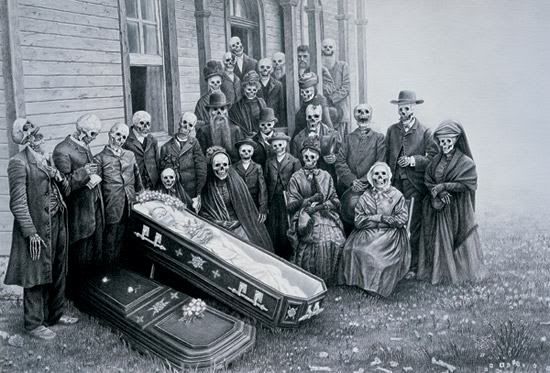
I came across this drawing of a strange, skeletal funeral while surfing the internet. Sadly, I don't remember quite where I got it from. I'd like to know what the name of it is and who the artist was.
If you happen to recognize it, please leave me a comment.
Monday, December 05, 2005
Unstructured Discovery
So here's the story: a student comes in late to a statistics class and notices two problems on the board. Assuming that they are assignments he jots them down and takes them home. He has a really hard time with them but finally manages to solve them a few days late. He brings them to his professor, apologizing for his tardiness. His professor tells him to leave them on his desk and he'll look them over.
A full six weeks passes before his professor wakes him up one Sunday morning exclaiming that he'd written an introduction to one of the papers and that he was sending it out for publication. It turns out that the two problems were examples of well known but unsolved problems which the student had, in fact, managed to solve.
Urban legend? Too good to be true? Surprisingly, no. Mind you, urbany versions of the story have been circulating around, but the core facts are true. The student in question was George Bernard Dantzig and the events of the tale transpired in 1938.
Snopes has a full account of this rather amazing story.
Thursday, December 01, 2005
Unstructured Bang
Still not well, my friends. Hence, no poem today. Instead, I came across a very interesting site that tests the old movie cliche of shooting a paddlelock off with a gun. It turns out that it's not as easy as you might suppose.
Saturday, November 26, 2005
Of Mice and Kidney Stones
Well, I thought that a long weekend would be the perfect respite for the writing of an essay. Alas, Santa's evil brother, Nackles, decided to deliver me an early present in the form of a kidney stone which means that my weekend is consisting of interludes of pain interspersed with interludes of Percocet-induced sleep.
At least I was able to enjoy a good Thanksgiving dinner before it struck.
I do want to clarify that I have no immediate plans to finish up part two of the Intelligent Design essay. Frankly, I've lost my train of thought on it and would rather not deliver a substandard conclusion simply for the sake of concluding it.
Friday, November 18, 2005
Unstructured Fun

 First an announcement: instead of doing regular Tuesday Fun articles, I've decided to do them on a less structured scheduled; hence, "Tuesday Fun" is now "Unstructured Fun".
For this first entry, Lore Sjöberg, formerly of Brunching Shuttlecocks, has put together a fun little web toy called Untitled States. Basically it's a set of pictures that you can self-caption.
It's a simple toy but, in my opinion, surprisingly fun to play around with. It also provides you with HTML so that you can add the resulting images to a web page or post them to a forum.
Have fun.
Thursday, November 17, 2005
Life Before Death

There are
Those zombies among us
Who purport to believe
In life before death.
I will not argue with them.
Suffice it to say
That we are certain
That it is the dead who walk,
That it is the dead who talk,
And that no one knows a thing
About what came before.
Photo courtesy of Anthéaïs
Wednesday, November 09, 2005
Immoliation

I sketch my future
From strewn embers
As I gather myself to myself
My vision blazes through
Imponderable eventualities
I see myself casting brightness
From a self-fueled pyre
I burn myself, again,
Consumed by hope.
Photo courtesy of Meganpru
Sunday, November 06, 2005
The Eschatologist
It's Monday. At precisely 7:16 in the morning, Eastern Daylight Time, the world ends. It does that a lot on Mondays.
It's a standard Christian apocalypse which means a long morning for me. It used to be that these things would just be a couple of days of plague, famine, et al, followed by a nice, neat Heavenly ascension and Judgment — hallelujah! Ever since the fundies polluted the zeitgeist, they've invariably included a tedious thousand-year reign of the Antichrist in which every last little tidbit of biblical hallucigenia gets played out in endless, banal variety.
If there's one thing I can't stand, it's a drawn out eschatology. That's why I love the techno-nerds. When they end the world it's usually something like some rogue grey goo that escapes from a secret lab — there's always a secret lab — that eats the world in three days, or some super-virus that makes everyone puke their innards up in a week, or an accidental black hole that devours the planet before lunch.
At 10:28 its zombies. Fucking horror freaks.
At 1:10, 1:31 and 1:56 we get Hindu, Islamic and, so help me, Mayan endings. This is why I drink.
I get a nice break before there's a nuclear holocaust at sundown. I haven't seen one of those since 1998. I actually like the nuke scenarios, at least when they don't have any damned mutant cannibal hoards. Nuclear wars are all pretty fireworks followed by a pleasant nuclear winter as mankind's dominion over the world comes to an end. They're also easy to clean up
Elder Gods at eight, war against the machines at nine, everything's a dream and the Dreamer is now waking up at ten and, finally, aliens destroy the planet at a quarter to midnight.
I was twelve years old when I got my gnosis. It was May of 1958. Most of the apocalypses back then were of the nuclear variety but this time it was giant bugs. Of course I didn't know anything about the ways that the world ends, back then. I was twelve and, as far as I was concerned, everything was ending for the first time ever.
The bugs in question were locusts. It was a standard horror movie. They came out of the Alamogordo but, in no time flat, they were everywhere.
I was a smart kid, a nearly perfect stereotype of a 50's science geek. I even, swear to The Great Unknown, had a junior chemistry set, a backyard telescope and, yes, a slide rule and a pocket protector. I knew that the bugs just didn't make any sense. Giant bugs violate the laws of physics and biology. They should have collapsed under their own weight, exoskeletons cracking from the strain. They shouldn't have been able to breath. The sure as hell shouldn't have been able to fly.
I remember being trapped in school, looking out at the street where the locust were ripping open cars and tearing apart pedestrians, and it just didn't make any sense, so I stopped believing in it. That's when things got weird.
You ever have a dream and you wake up just enough to know that it's not making sense but not enough to realize that you're actually dreaming? It was like that. Time suddenly got jumpy as my mind tried to force what was happening into some kind of semi-sensible template. The bugs flickered and were replaced by insectile robots. Then they flickered back. Everything jerked and then I realized that the bugs were really aliens. Hugh saucers floated in the afternoon sky. Then the disks crashed to the ground and the bugs went back to being bugs. The world lurched and, instead of bugs, they were Commie tanks cleverly disguised as bugs. Then they went back to being bugs again.
I don't know how long this went on. Time didn't make sense. All I knew is that there was no well in hell that overgrown locusts were destroying the world and that I was not going to let that be the case. Eventually a hand clasped my shoulder and some guy I didn't know said, "Kid, what the hell do you think you're doing?"
I turned around. He was a tall, muscular guy with a weirdly feminine look, especially around his eyes.
I remember stammering that none of this made any sense. He smiled and told me that I had to relax and let it play itself out. He told me that I couldn't force it. I had no idea what "it" was supposed to be. He touched my forehead and everything went hazy.
Tuesday is a trifecta of ecological, economic and epistemological collapses, which is not a bad day as these things go.
I woke up in my own bed. I got up and ran to the living room in a panic. I remember my mom being very cross with me. She told me to march back into my bedroom and put some clothes on because, "We're not animals!"
I knew better than to ask about rampaging radioactive monstrosities. Clearly it had, after all, been a dream even though it seemed far too vivid to be one. It was Saturday (so what the hell happened to Friday?) and I desperately needed to clear out my head, so I told my folks that I was going to the park.
When I got there, I found myself lost in thought. I think that I'd finally managed to convince myself that I'd imagined everything when, off in the distance, an air raid siren went off.
"Don't panic."
There he was, again: the same big frame, the same feminine eyes. I don't mind telling you that he really creeped me out.
"Who are you," I demanded. "What's going on?"
He said that, from the sounds of it, we were about to experience a nuclear war. I could feel my legs going rubbery. Giant bugs, no way, but a nuclear war was something that I could, in fact, believe in. I wondered how soon it would be before the soviet bombers dropped their awful cargo on us.
"My name is Elaios," he told me, "I'm the archon of the North American continent. You can call me El."
I had no idea what he was talking about. All I knew was that I was about to die. It must have shown on my face.
"Look, kid, this isn't any more — or less — real that what happened yesterday. The world's about to end, but that's nothing to worry about. It does it all the time."
Wednesday is sci-fi day: comets, gamma ray bursts, a planet busting anti-matter explosion (from a secret lab), and the Borg.
The world has been coming to an end since the beginning. I'm told that, in the first fractions of a femtosecond after its creation, the universe collapsed back on itself, or expanded out into a thin haze of nothingness, more times that can be counted. Even when the expansion was just right there were other things that went wrong. Sometimes there was too much gravity and everything collapsed into black holes. Other times the strong force was a bit too weak and we ended up with a universe that only had hydrogen. Lots of things could, and did, go wrong. Apparently it took a fair amount of tuning just to get something stable enough to allow for the existence of people.
Once we were on the scene, things really got out of hand.
The world doesn't end on Thursday. The world never ends on Thursday. Don't ask me why. I'm just glad that I get a regular day off.
An A-bomb went off less than half a block away. I was instantly flashed into atoms as was "call me El". It's a painless way to die, which is another reason why I like nuclear wars.
I suppose that I should have been more surprised to still have any sense of awareness, but I assumed that I was a ghost and that I'd be going up to Heaven soon. I was, however, surprised at how solid I felt and at how solid Elaios looked. He knelt down to my eye level and asked me, "Do you wonder why the world doesn't ever seem to completely fall apart?"
The highlight of Friday was a rampaging queer hoard running around buggering, burning and applying forced makeovers to unwilling straight guys. When you've seen as many rampaging hoards as I have you appreciate the fine details that illuminate the specific angsts that generate them.
Awareness changes reality. I suppose that there's some deep quantum explanation to account for this but it's been decades since I lost my simple faith in the explanatory power of science. All I know is that it's so.
The very first intelligence was the Demiurge. He's El's boss, which makes him my boss's boss. In the beginning, he touched the spark that ignited the universe and has been spending the rest of Time doing his best to make sure that that precious, divine flickering, which is our Cosmos, doesn't fade. Or so El says. Some folks who've heard about him think that he's a godly semi-abortion who created this universe to trap us in a world of lies and illusions. Whatever.
The important thing is that we're all bending reality to our expectations. If you want to put some kind of postmodernist or New Age spin on that, be my guest. What matters is that, most of the time, our competing desires to remake the universe into our own images cancels out. The Demiurge is the tie-breaker. It prefers a universe of orderly physical laws, which is what we mostly get. Frankly, that works for me, too.
The problem is that reality just isn't very stable. People are pessimistic. They look out at the universe and some deep part of them thinks that it's all just a little good to be true. That doubt translates into eschatology. Sometimes — often — the balance tips and the world goes spiraling down into one of a million different oblivions.
Saturday starts with run away global warming and ends with an endless ice age. The irony fails to amuse me.
"You ever hear the story of the virtuous men?"
I shook my head.
"It's a story that you find in a lot of mythologies. Supposedly there are a handful of virtuous men — sometimes seven, sometimes nine, or some other mystically significant number — whose virtue prevents the world from ending."
Off in the distance I could see blasted buildings. Every so often there'd be a flash on the horizon that I assumed was another bomb going off. I toyed with a chunk of fused glass that I had pulled from the ground.
"I suppose that you're going to tell me that you're one of those guys, right?"
He smiled. "No. I'm not particularly virtuous and the world keeps ending whether I like it or not. I'm just one of the guys who gets to put it back together after it falls apart."
It's Sunday. Aside from a lone AI gaining godlike intelligence and turning the whole solar system into computronium, it's been a quiet morning.
I'm having coffee with El. I've been the sub-archon in charge of the Eastern Seaboard for almost five decades now.
"What's the point, El?"
I'm tired. I'm tired of living through catastrophe after catastrophe. I'm tired of getting murdered. I'm tired of being blown to smithereens. I'm tired of being butchered, raped, dismembered and eaten. I'm tired of being sucked into black holes and tired of living through every inane nihilistic fantasy that the Collective Unconscious spews out.
I'm tired of fixing everyone else's mess.
He absently taps his mug with his spoon a few times. It's just one a dozen annoying habits that he has.
"What I can I tell you, kid? I've been doing this since King Tut was in diapers and I've thought about calling it quits thousands of times. I never do, though."
He shrugs. "I know it sounds corny, but I believe in the world. I believe in humanity."
I tell him that I can't do it anymore, that I just want to end it all, even if that means ending myself. I tell him that I've got a gun at home with a bullet in the chamber. I tell him that I just wanted to say goodbye and that he's going to need to find someone else to manage this little corner of our fragile world. I've got my own eschatology to take care of.
He tells me that I just need a vacation. He leans over and takes my gnosis. I had no idea that he could do that.
It's Monday, again. I've got the hangover from Hell. I clutch my head, trying not to puke. I can tell it's going to be one of those days.
At least it's not the end of the world.
Friday, November 04, 2005
State of the Blog Update
As promised, I will be starting up the blog soon. I'm giving some thought to how I want to do so. I'm still a bit worried about just how much time I'm going to have to dedicate to it and whether or not I should, in fact, make it just a bit more unstructured. I think that I will go back to doing regular poetry postings every Thursday. I'm not entirely sure if I want to keep Tuesday Fun as a regular feature or just go to posting fun stuff as it comes on an irregular basis. The Sunday posts are the most up in the air. I like writing essays but I don't want to reach the point of writing an essay for the sake or writing one. I'm also thinking that I'd like to do more reviews and stories (in fact, this Sunday I will have a fresh story up).
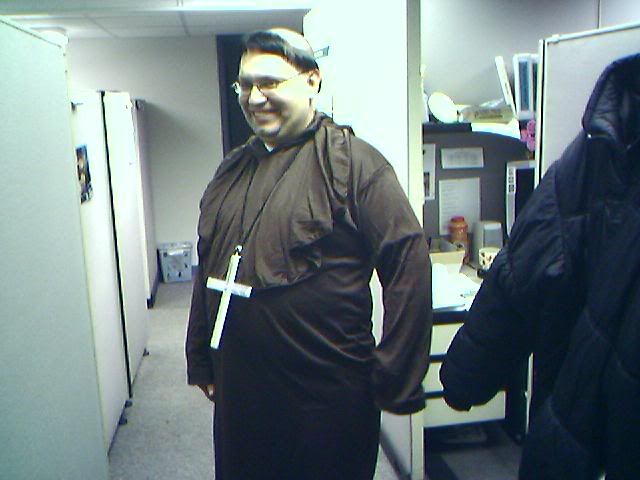
In the meanwhile, he's a pic of the costume I wore this Halloween. Please note that the tonsure (i.e., "monk's cut") is not a wig.